<?xml version="1.0" encoding="UTF-8"?>
<?xml-stylesheet type="text/xsl" href="/stylesheets/feed.atom.xml" media="screen"?>
<feed xml:lang="en-US" xmlns="http://www.w3.org/2005/Atom">
  <id>tag:global.nd.edu,2005:/news-events/news</id>
  <link rel="alternate" type="text/html" href="https://global.nd.edu"/>
  <link rel="self" type="application/atom+xml" href="https://global.nd.edu/news-events/news.atom"/>
  <id>tag:global.nd.edu,2005:/latest</id>
  <title>Notre Dame Global | News</title>
  <updated>2026-08-11T10:04:46-04:00</updated>
  <link rel="alternate" type="text/html" href="https://global.nd.edu/"/>
  <link rel="self" type="application/atom+xml" href="https://global.nd.edu//news-events/news.atom"/>
  <subtitle>Explore bold ideas, big dreams, and new journeys across 12 global locations and study abroad opportunities in 38 countries. Answer the call to become a global citizen and shape a better world.</subtitle>
  <entry>
    <id>tag:global.nd.edu,2005:News/183092</id>
    <published>2026-08-11T10:04:46-04:00</published>
    <updated>2026-08-11T16:36:34-04:00</updated>
    <link rel="alternate" type="text/html" href="https://global.nd.edu/news-events/news/the-one-thing-you-should-know-about-notre-dame-dublin/"/>
    <title>The one thing you should know about Notre Dame Dublin</title>
    <summary type="text">
      <![CDATA[…]]>
    </summary>
    <content type="html">
      <![CDATA[<figure class="image image-default"><img src="https://global.nd.edu/assets/651794/950x/the_one_thing_graphic_1200_x_400_px_3_.webp" alt='Text: "[the] ONE THING" on a dark blue world map. "the" is golden and bracketed; "ONE THING" is large, white.' width="950" height="317"></figure>
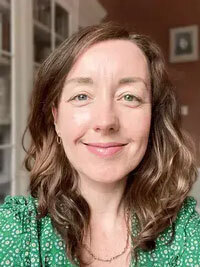
<figure class="image image-right"><img src="https://global.nd.edu/assets/672475/1_ecdelany_2.jpg" alt="Smiling woman with wavy brown hair, one blue eye and one green eye, wearing a green patterned top." width="200" height="267">
<figcaption>Eimear Clowry Delaney, Michael J. Smurfit Director of Notre Dame Dublin</figcaption>
</figure>
<p><em>This story is part of Notre Dame Global's series titled "<a href="https://global.nd.edu/news-stories/news/notre-dame-globals-the-one-thing-series-featuring-the-universitys-twelve-global-locations/">The One Thing.</a>"</em></p>
<p>In 2026, we are taking a new look at Notre Dame’s 12 global locations by asking each of their directors one question: “What is the one thing you would like the Notre Dame community to know about your programs, your achievements, your goals, or your aspirations?”</p>
<p>We focus now on <a href="https://dublin.nd.edu/">Notre Dame Dublin</a>, headed since 2024 by <a href="https://global.nd.edu/about/people/eimear-clowry/">Eimear Clowry Delaney</a>, Michael J. Smurfit Director, who joined the Keough Naughton Notre Dame Centre in 2008 and previously served as its senior associate director.</p>
<hr>
<h3>What is the one thing you want the Notre Dame community to know about Notre Dame Dublin?</h3>
<blockquote>
<p>“Student learning and teaching are at the core of everything we do.”</p>
</blockquote>
<p><strong>EIMEAR CLOWRY DELANEY:</strong> Notre Dame Dublin was founded in 1998—nearly 30 years ago. That is our origin story—we began as a student center, a learning center in Dublin. All of our current programs and collaborations spring from that history.</p>
<figure class="image image-right"><img src="https://global.nd.edu/assets/666283/450x/2_mc_824.jpg" alt="Blue door of the Notre Dame Centre in Dublin, adorned with blue and yellow flowers, and a green ND logo carpet." width="450" height="299">
<figcaption>Front door of O’Connell House in Dublin, Ireland</figcaption>
</figure>
<p>Since the center’s founding, the Notre Dame students who come to Dublin have been the pathfinders in Ireland for the University as a whole and for its many collaborations with Irish society more broadly. The fifty or so undergraduates who come to us each semester for a study abroad experience attend classes—and are fully immersed—in one of three universities: Dublin City University, Trinity College Dublin, or University College Dublin. And, when one of us at O’Connell House encounters a potential partner or collaborator—if they've had an experience with our students—they are more than willing to engage with us. They trust us based on the experiences they've had with our young people—whether through one of the three universities or through one of our many internship placements during the semester or summer—at the National Gallery of Art or the Department of Foreign Affairs, for instance.</p>
<p>A beautiful, organic respect has been built for Notre Dame as an institution through these outstanding young people, from their desire to be in Ireland, their curiosity for the island they inhabit, and for their work during the time they're with us.</p>
<hr>
<h3>Why is that one thing—that student learning and teaching are at the core of everything you do—so important to Notre Dame Dublin?</h3>
<blockquote>
<p>“Making student learning and teaching central is how we engage with the purpose of a university—to educate and to inspire brilliant young minds to not only transform the world, but to transform how they <em>see</em> the world, how they <em>feel</em> in the world, and how they want to <em>be</em> in the world in the future.”</p>
</blockquote>
<p><strong>EIMEAR CLOWRY DELANEY:</strong> Our students come to us with ambition, curiosity, drive, creativity, and diverging opinions. That makes them brave, and these qualities make us brave, too.</p>
<p>Related to that bravery, one thing I am passionate about is that a part of studying abroad, researching abroad, and learning abroad is getting lost. If a program is too prescriptive, students aren’t able to see that while Ireland is an ancient island, we are also very advanced in today’s world. That can surprise some young people—but that can only happen if they are given the opportunity to explore, to get lost a bit, and go farther and deeper than one does with a typical tourist experience.</p>
<figure class="image image-right"><img src="https://global.nd.edu/assets/666298/450x/3_img_6847.jpg" alt="Man in grey sweater and pom-pom hat holds an orange W. B. Yeats book, speaking to students on a rocky hill." width="450" height="300">
<figcaption>Professor Kevin Whelan teaches the poetry of W.B. Yeats as the students sit atop Knocknarea, County Sligo, on what is said to be ancient Celtic warrior goddess Queen Medb's Cairn, a 5,000-year-old neolithic passage tomb. The culture, landscape, and folklore in this area of Sligo, now known as "Yeats Country," was hugely influential to W.B. Yeats.</figcaption>
</figure>
<p>For that reason, here at Notre Dame Dublin, our core focus is building community, learning, and growing together through, as we say, “the soles of our feet.”</p>
<p>Our motto is <em>Is ar scáth a chéile a mhaireann na daoine</em>, an Irish proverb that translates to "People live in the shelter of each other,” reflecting our interconnectedness and reliance on community to survive and thrive.</p>
<p>The hundreds of students who have embraced this way of study abroad are a testimony to its effectiveness. One such student is Meera Baakta ‘26, who says, “In Dublin, I was able to explore questions similar to those across science and development that I studied at Notre Dame’s home campus, but within a different intellectual and social ecosystem. Connecting with professors and peers across courses such as Trinity College Dublin’s EthicsLab, I was able to expand my understanding of complex dilemmas and enrich my experience by learning alongside people formed by different histories and perspectives. I also began to learn the Irish language in classes at O’Connell House, and then continued my studies back on campus.” <a href="#meera">See Meera's story below</a></p>
<hr>
<p><strong> </strong></p>
<h3>What does that one thing reveal about Notre Dame Dublin and Ireland overall?</h3>
<blockquote>
<p>“We Irish are a curious people, an island of people within a very small land mass who live in close proximity to each other. We build strong relationships within our own, sometimes parochial, communities. But we thrive in getting to know new people, and that curiosity—of wanting to interrogate, discuss, converse, or debate with others—is a very strong part of Irish culture.”</p>
</blockquote>
<p><strong>EIMEAR CLOWRY DELANEY:</strong> This quality of curiosity about how others think is at the core of who we are as a people. And, to be able to bring new people into the fold who may not think the same, that in itself is very Irish.</p>
<p>Curiosity works both ways. A key opportunity with international education is to understand that, wherever they claim citizenry, people are not really that different. The challenges we face are very much shared. With that realization comes a desire to problem-solve together. So, as a little island on the periphery of the Atlantic and of Europe, we Irish have traditionally felt rather isolated and alone. But now, Ireland has taken on a new identity—one of being a changemaker. We have a tiny population, but we have a very significant voice in the world. We will flourish and thrive only if we share that with the world and invite and welcome other people to be with us.</p>
<figure class="image image-right"><img src="https://global.nd.edu/assets/666303/450x/4_panel_discussion.jpg" alt="Two women, one gesturing, lead a panel on Michael Cronin's &quot;Translating Ireland&quot; at Notre Dame Dublin for an audience." width="450" height="300">
<figcaption>As part of the Translating Ireland Conference, University of Notre Dame professor Clíona Ní Ríordáin chaired the "Translating Irish Literature out of Ireland" panel discussion, which featured translators Marco Sonzogni (Victoria University, New Zealand), Marie Hermet (France), and Indrek Õis (Estonia).</figcaption>
</figure>
<p>Interrogating how Ireland has been a changemaker was one of the subjects of the <a href="https://global.nd.edu/news-events/events/2026/04/16/377367-translating-ireland-symposium/">“Translating Ireland” symposium</a> Notre Dame Dublin hosted with several partners this past April to mark the 30th anniversary of the publication of the influential book by Michael Cronin, <em>Translating Ireland</em>. Led by <a href="https://irishlanguage.nd.edu/people/cliona-ni-riordain/">Clíona Ní Ríordáin</a>, the Thomas J. and Kathleen M. O’Donnell Chair in Irish Language and Literature, participants explored the central role translation played in the contact zone between languages as well as how it shaped the development of the languages of literature and the construction of identity in Ireland.</p>
<p>Looking ahead, I am very excited about an upcoming partnership within the University’s <a href="https://strategicframework.nd.edu/initiatives/arts/">Arts Initiative</a> between Notre Dame Dublin and <a href="https://mexico.nd.edu/">Notre Dame Mexico</a>. We are excited to make a joint announcement soon that will include all the details.</p>
<p><strong>Learn more about the work of <a href="https://dublin.nd.edu/">Notre Dame Dublin</a> and the University of Notre Dame’s <a href="https://global.nd.edu/global-network/">global network</a>, or browse related articles:</strong></p>
<ul>
<li><a href="https://dublin.nd.edu/news-stories/news/daniel-oconnell-the-emancipator-documentary-launched-by-notre-dame-dublin/">Daniel O’Connell: The Emancipator Documentary Launched by Notre Dame Dublin</a></li>
<li><a href="https://dublin.nd.edu/news-stories/news/clare-cullinan-named-valedictorian-bennett-schmitt-selected-as-salutatorian-for-the-class-of-2025/">2026 Valedictorian and Salutatorian both studied in Dublin </a></li>
<li><a href="https://global.nd.edu/news-events/events/2026/04/16/377367-translating-ireland-symposium/">With several partners, including Notre Dame Dublin, Professor Clíona Ní Ríordáin co-organizes a symposium to mark the 30th anniversary of the publication of the influential book Translating Ireland by Michael Cronin</a></li>
<li><a href="https://dublin.nd.edu/news-stories/news/notre-dame-dublin-students-explore-the-european-pilgrimage-tradition/">Notre Dame Dublin students explore the European pilgrimage tradition</a></li>
<li><a href="https://dublin.nd.edu/news-stories/news/notre-dame-students-embrace-community-engaged-learning-in-ireland/">Notre Dame students embrace community-engaged learning in Ireland</a></li>
<li><a href="https://dublin.nd.edu/news-stories/news/notre-dame-dublin-supports-four-nanovic-sustainability-research-fellows/">Notre Dame Dublin supports four Nanovic sustainability fellows</a></li>
<li><a href="https://stories.nd.edu/stories/ireland-series/a-bogs-life/">Mariana Silva ND ’21 and Trinity College Dublin graduate student studies a bog’s life and why preserving Ireland’s bogs is so important</a></li>
</ul>
<hr>
<h2>Learn more about the collaborative work and partners of Notre Dame Dublin</h2>
<hr>
<h3>The Legacy of Daniel O’Connell</h3>
<figure class="image image-default"><img src="https://global.nd.edu/assets/666305/1000x/danieloconnell_riam_32_cropped.jpg" alt="Four people smile. Left to right: man with beard/glasses, woman in green, man in suit, man with curly hair. ND Golden Dome.">
<figcaption>Eimear Clowry Delaney, Michael J. Smurfit Director of Notre Dame Dublin, attends the <em>Daniel O’Connell: The Emancipator</em> documentary premiere alongside (left to right) the documentary director Ruán Magan, University of Notre Dame Vice President &amp; Associate Provost Michael Pippenger, and composer and musician Colm Mac Con Iomaire.</figcaption>
</figure>
<p>The Keough Naughton Notre Dame Centre at O’Connell House is the home of Notre Dame Dublin. Located at Number 58, Merrion Square, the centre was once home to the celebrated early nineteenth-century Irish Catholic political leader Daniel O’Connell.</p>
<p>O’Connell is the subject of <a href="https://dublin.nd.edu/news-stories/news/daniel-oconnell-the-emancipator-documentary-launched-by-notre-dame-dublin/">a documentary</a> titled <em>Daniel O’Connell: The Emancipator</em>, produced by Create One in association with the University of Notre Dame, University College Cork, and RTÉ, Ireland’s national television and radio broadcaster.</p>
<p>The documentary traces O’Connell’s journey from Kerry lawyer to global advocate for justice. Known as “The Liberator,” he secured Catholic Emancipation, pioneered non-violent mass political mobilization, and inspired democratic movements around the world.</p>
<p>The release of <em>Daniel O’Connell: The Emancipator</em> will form part of a four-year-long program of commemorations and research, from O’Connell’s 250th birthday in 2025 to the 200th anniversary of Catholic Emancipation in 2029, inviting audiences to reflect on how his vision for justice and democracy continues to shape our world.</p>
<p>The <a href="https://dublin.nd.edu/events/2025/11/25/gala-premiere-of-new-documentary-daniel-oconnell-the-emancipator/">gala premiere </a>of the documentary was held in Dublin in November 2025.</p>
<p>There will be a screening of The Emancipator on the Notre Dame campus Friday, November 13th, at the DeBartolo Performing Arts Center, and another screening at the Chicago Consulate Film Festival on Sunday, November 15th.<a id="meera"></a></p>
<hr>
<p><strong> </strong></p>
<h3>More than a Semester Abroad</h3>
<figure class="image image-right"><img src="https://global.nd.edu/assets/666307/350x/6_meera_b_cropped.jpg" alt="Meera Bhakta. Smiling woman in black sleeveless top with red/gold stripes and jeans, stands by colorful flowers and ornate stone building.">
<figcaption>Meera Bhakta, ‘26</figcaption>
</figure>
<p><em>Meera Bhakta ‘26 graduated with a major in science preprofessional studies and a minor in international development. During the spring 2025 semester, she studied at Trinity College Dublin and will return to Trinity this fall as a Naughton Fellow pursuing a masters of science degree in translational oncology.</em></p>
<p><strong>MEERA BHAKTA:</strong> For my study abroad experience at Notre Dame, I explored programs from Santiago to Copenhagen, hoping there would be a clear sign pointing me in one direction. Eventually, I chose Trinity College Dublin because it allowed me to take a wide range of courses I was interested in and would allow me to fully integrate into a host university. At the time, I had researched Trinity extensively, but I knew relatively little about Ireland itself. Looking back, that is part of what made the experience so impactful. By not knowing, I was open to the surprises Ireland had in store for me. <br><br>In Dublin, I was able to explore questions similar to those I studied at Notre Dame across science and development, but within a different intellectual and social ecosystem. Connecting with professors and peers across courses such as EthicsLab, I was able to expand my understanding of complex dilemmas and enrich my experience by learning alongside people formed by different histories and perspectives.</p>
<p>Beyond the classroom, Dublin also impacted me through the people and communities I engaged with. Every Tuesday, I volunteered with an after-school program at St. Catherine’s Church through the Solas project. Some afternoons were spent helping with homework, others playing outside, organizing holiday activities, or sharing stories. Those Tuesdays filled my semester with an unexpected source of laughter and friendship, and taught me about allowing myself to be shaped by the people around me.</p>
<p><strong> </strong></p>
<p>O’Connell House also became a valuable home base throughout the semester, providing a place for conversations, reunions with friends studying across the city, tea and digestive breaks, and opportunities to learn more about the Irish language, history, and culture. I began studying Irish through classes there, and then continued my studies back on campus.</p>
<p><strong> </strong></p>
<p>I am so grateful to be returning to Dublin this fall with the support of the Naughton Fellowships to pursue an MSc in Translational Oncology at Trinity College Dublin. My time in Dublin helped me to see Ireland not just as a semester abroad, but as a place where I can continue to grow intellectually, personally, and professionally. I hope to continue studying the Irish language upon my return and plan to visit the Gaeltacht.</p>
<hr>
<p><strong> </strong></p>
<h3>Imagallamh: the Keough-Naughton Summer School in Irish Studies</h3>
<figure class="image image-right"><img src="https://global.nd.edu/assets/666308/450x/7_img_2236jpg.jpg" alt="A man in a dark shirt speaks at a podium to an attentive audience in a room with a University of Notre Dame banner." width="450" height="338">
<figcaption>Declan Kiberd delivering a lecture to the graduate students attending Imagallamh, the Keough-Naughton Summer School in Irish Studies</figcaption>
</figure>
<p>A summer seminar for graduate students in the humanities is held every year in Ireland between Notre Dame Dublin and <a href="https://kylemore.nd.edu">Notre Dame Kylemore</a>.</p>
<p>Called “<a href="https://dublin.nd.edu/programs/imagallamh-the-keough-naughton-summer-school-in-irish-studies/">Imagallamh</a>,” which means “mutual discourse,” the seminar seeks to emphasize the international and comparative elements of Irish studies. It also aims to bring the next cohort of scholars in the field into meaningful dialogue with one another and with key figures in Irish scholarship, the arts, and society. In addition to Notre Dame students, this year’s cohort included students from Britain, Canada, India, Ireland, Italy, Latin America, and the US. Each student received a fully-funded scholarship.</p>
<p>Directed by <a href="https://english.nd.edu/people/barry-mccrea/">Barry McCrea</a>, the Donald R. Keough Family Professor of Irish Studies and Professor of English at the University of Notre Dame, with the collaboration of <a href="https://irishlanguage.nd.edu/people/cliona-ni-riordain/">Clíona Ní Ríordáin</a>, the Thomas J. and Kathleen M. O’Donnell Chair in Irish Language and Literature, Imagallamh was launched in 2024 as a new iteration of the <a href="https://irishstudies.nd.edu/">Keough-Naughton Institute’s</a> IRISH Seminar, which ran from 1999 to 2022. That seminar was held in Ireland and locations around the globe, with such themes as Ireland and Britain, Classical Influences, Irish Modernisms, Ireland and Italy, and Peripheral Modernities: Ireland, Argentina, and Latin America.</p>
<p>The theme of the 2026 Imagallamh seminar was Urban Ireland. Across two weeks, students engaged with academics and writers to explore the historical, cultural, and literary dimensions of settlement on the island—from its earliest origins, including prehistoric settlements, early monastic complexes, Viking towns, and British garrisons, through to the life of Ireland’s modern cities.</p>
<p><strong> </strong></p>
<p>Some highlights of the Dublin week of the seminar included lectures on Sean O’Casey and the development of Dublin’s built environment from the Georgian city through independence, an interdisciplinary conversation between leading Dublin architects and poets, and a trip to the Tenement Museum on Henrietta Street.</p>]]>
    </content>
    <link rel="enclosure" type="image/jpeg" href="https://global.nd.edu/assets/666283/2_mc_824.jpg" title="Blue door of the Notre Dame Centre in Dublin, adorned with blue and yellow flowers, and a green ND logo carpet."/>
    <author>
      <name>Mary Hendriksen</name>
    </author>
  </entry>
  <entry>
    <id>tag:global.nd.edu,2005:News/184622</id>
    <published>2026-08-07T15:41:00-04:00</published>
    <updated>2026-08-07T15:41:38-04:00</updated>
    <link rel="alternate" type="text/html" href="https://global.nd.edu/news-events/news/notre-dame-faculty-prestigious-national-science-foundation-early-career-awards-2026/"/>
    <title>Notre Dame faculty win prestigious National Science Foundation early career awards</title>
    <summary type="text">
      <![CDATA[Five researchers at the University of Notre Dame earned a Faculty Early Career Development Program Award (CAREER), the most prestigious award from the National Science Foundation (NSF) for early-career faculty. Those who win CAREER…]]>
    </summary>
    <content type="html">
      <![CDATA[<p>Five researchers at the University of Notre Dame earned a Faculty Early Career Development Program Award (CAREER), the most prestigious award from the National Science Foundation (NSF) for early-career faculty.</p>
<p>Those who win <a href="https://www.nsf.gov/funding/opportunities/career-faculty-early-career-development-program">CAREER Awards</a> have the potential to serve as academic role models in research and education and to lead advances in the mission of their department or organization, according to the NSF. Each awardee at Notre Dame received more than half a million dollars in funding to support their research.</p>
<p>“We are thrilled to celebrate this latest cohort of CAREER Award recipients. Their forward-thinking research reflects Notre Dame's unwavering commitment to discovery that serves the common good,” said <a href="https://research.nd.edu/people/jeffrey-rhoads/">Jeffrey F. Rhoads</a>, the John and Catherine Martin Family Vice President for Research and professor in the <a href="https://ame.nd.edu/">Department of Aerospace and Mechanical Engineering</a>. “We appreciate that the National Science Foundation is supporting these high-impact research projects.”</p>
<p>Below are Notre Dame’s 2026 awardees, along with brief descriptions from their abstracts:</p>
<figure class="image image-left"><img src="https://research.nd.edu/assets/671651/fullsize_square/hsing_ta_chen.jpg" alt="A man with dark hair and glasses smiles. He wears a cream turtleneck sweater under a grey blazer." width="250" height="200"></figure>
<p><a href="https://chemistry.nd.edu/people/hsing-ta-chen/">Hsing-Ta Chen, assistant professor in the Department of Chemistry &amp; Biochemistry</a> in the College of Science, will pioneer approaches to harness the interaction between light and molecules to power the next generation of energy and quantum technologies with his project, “Novel Theoretical Tools for Dynamics of Interacting Light-Matter Systems.” Light and molecules are constantly exchanging energy at the quantum scale across complex environments, such as inside tiny mirrors or near metal surfaces. His research group will develop methods that allow scientists to understand and predict how molecules behave in these complex environments.</p>
<hr>
<figure class="image image-left"><img src="https://research.nd.edu/assets/671654/fullsize_square/saurja_dasguptajpg.jpg" alt="Man with dark curly hair and glasses in a lab, wearing a maroon zippered sweater, looking forward." width="236" height="200"></figure>
<p><a href="https://chemistry.nd.edu/people/saurja-dasgupta/">Saurja DasGupta, assistant professor in the Department of Chemistry &amp; Biochemistry</a> in the College of Science, is seeking to understand the earliest chemical reactions and molecules involved in the first living cells for his project, “Reconstructing Primordial Life of the Lost RNA World.” Early life is thought to have used RNA as its genetic material as well as its enzymes. His research group aims to understand how RNA molecules could have facilitated the emergence of the first self-replicating cells. This project addresses this fundamental question by building simplified models of primitive cells, or protocells, in the laboratory.</p>
<hr>
<figure class="image image-left"><img src="https://research.nd.edu/assets/671653/fullsize_square/meenal_datta_960.jpg" alt="Woman with long dark hair and a teal blazer stands in a laboratory, looking forward with a neutral expression." width="360" height="200"></figure>
<p><a href="https://engineering.nd.edu/faculty/meenal-datta/">Meenal Datta, the Jane Schoelch DeFlorio Collegiate Professor of Aerospace and Mechanical Engineering</a> in the College of Engineering, will investigate cancer with her research, “Mechanisms of Tumor Growth-Induced Immunomechanical Dysfunction.” The work is part of a newer area of research called immunomechanics, which lies at the intersection of mechanobiology and immunology. Her project investigates how these physical forces interfere with the ability of immune cells to find and destroy cancer cells, ultimately allowing tumors to grow unchecked. By uncovering how mechanical forces disrupt the immune system, this work addresses a fundamental gap in understanding how biology and physics interact in human health.</p>
<hr>
<figure class="image image-left"><img src="https://research.nd.edu/assets/671652/fullsize_square/kaiyu_fu.jpg" alt="Asian man with glasses in a white collared shirt, smiling subtly against a plain gray background." width="250" height="200"></figure>
<p><a href="https://chemistry.nd.edu/people/kaiyu-fu/">Kaiyu Fu, assistant professor in the Department of Chemistry &amp; Biochemistry</a> in the College of Science, will develop new chemical measurement tools that seek to help scientists detect and distinguish closely related small molecules in complex environments with his work, “Integrating Nanoconfined Interfaces and Aptamer Switches for Autonomous, Electrochemical Imaging of Chemical Analogs.” Many important molecules in medicine, biology, environmental monitoring, and manufacturing differ only slightly in structure, making them difficult to measure selectively in real time. The project would create electrochemical sensor platforms that use nanoscale materials and molecular recognition switches to identify chemical analogs without relying on large laboratory instruments.</p>
<hr>
<figure class="image image-left"><img src="https://research.nd.edu/assets/671655/fullsize_square/petr_stepanov.jpg" alt="A young man with brown hair and a grey speckled shirt looks directly at the camera with a neutral expression." width="250" height="200"></figure>
<p><a href="https://physics.nd.edu/people/petr-stepanov/">Petr Stepanov, assistant professor of Physics &amp; Astronomy</a> in the College of Science, will study new types of materials, known as moiré materials, created by stacking extremely thin layers of matter with precise alignment and leading to unusual and potentially useful electronic behavior in his project, “Towards a Unified Optical View of Strong Correlation in Moiré Quantum Matter.” These new types of materials can switch between conducting, insulating, and superconducting states — properties that are important for future technologies but remain poorly understood. The research combines optical and electrical measurements to probe how these materials respond to energy and heat at very small scales, providing insight into how their internal structure governs their macroscopic behavior.</p>
<p>Established in 1995, NSF CAREER Awards currently support 34 active research projects at the University of Notre Dame. To learn more about the program, visit the <a href="https://nsf.gov/funding/opportunities/faculty-early-career-development-program-career">NSF’s information page</a>.</p>
<p class="attribution">Originally published by <span class="rel-author">Deanna Csomo Ferrell</span> at <span class="rel-source"><a href="https://research.nd.edu/news-and-events/news/notre-dame-faculty-prestigious-national-science-foundation-early-career-awards-2026/">research.nd.edu</a></span> on <span class="rel-pubdate">August 05, 2026</span>.</p>]]>
    </content>
    <link rel="enclosure" type="image/webp" href="https://global.nd.edu/assets/672161/careers_fy26_headshots.webp" title="Five researchers pose for headshots."/>
    <author>
      <name>Deanna Csomo Ferrell</name>
    </author>
  </entry>
  <entry>
    <id>tag:global.nd.edu,2005:News/183420</id>
    <published>2026-08-07T11:13:00-04:00</published>
    <updated>2026-08-07T11:15:44-04:00</updated>
    <link rel="alternate" type="text/html" href="https://global.nd.edu/news-events/news/notre-dame-global-in-photos-july-2026/"/>
    <title>Notre Dame Global in Photos: July 2026</title>
    <summary type="text">
      <![CDATA[July’s stories stretched from career-launching workdays to a night beneath the stars. Students wrapped summer placements with organizations in Ireland and Mexico, gaining experience and local perspective that can shape their next steps. In Beijing, a visit with business leaders offered insight into…]]>
    </summary>
    <content type="html">
      <![CDATA[<p>July’s stories stretched from career-launching workdays to a night beneath the stars. Students wrapped summer placements with organizations in Ireland and Mexico, gaining experience and local perspective that can shape their next steps. In Beijing, a visit with business leaders offered insight into cross-cultural work, while in Santiago, students traded city lights for the wide-open skies of the Elqui Valley.</p>
<p>Scholars gathered in Rome to consider the intersection of religion and global politics, and a conversation in Jerusalem explored philosophy’s place in confronting complex societal issues. New undergraduate research students arrived in South Bend, Notre Dame families and alumni in Mumbai celebrated students preparing for a new chapter, and researchers in Brazil came together around shared scientific questions. Scroll on for a glimpse of the people, ideas, and unexpected moments that made July memorable across Notre Dame's global network.</p>
<hr>
<h2>DUBLIN</h2>
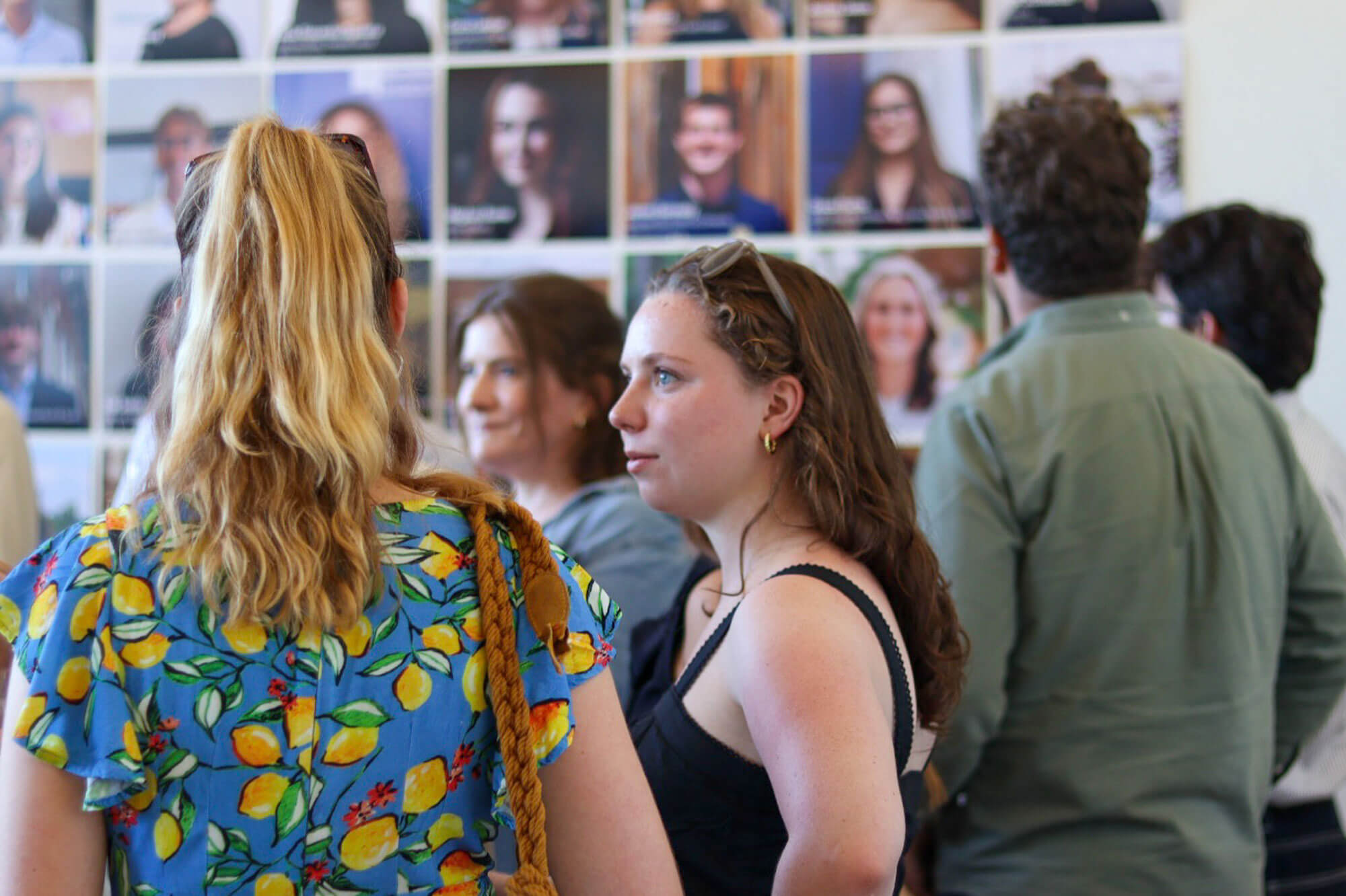
<figure class="image image-default"><img src="https://global.nd.edu/assets/671968/fullsize/dublin.jpg" alt="Crowd views a wall of portraits. Prominent: woman in lemon dress, woman in black, man in green shirt facing wall." width="2000" height="1332"></figure>
<p><a href="https://dublin.nd.edu">Notre Dame Dublin</a> held its annual end-of-summer celebration for the <a href="https://dublin.nd.edu/programs/irish-internship-program/">Irish Internship Program</a> at O’Connell House. The team was joined by the most recent cohort of interns, respective partners, and benefactors, bringing the 8-week program to a close. Across the two months, students were immersed in the work of their host organizations, working alongside Irish employees and gaining valuable, pragmatic experience, as one step in kick-starting their career trajectory.</p>
<hr>
<h2>ROME</h2>
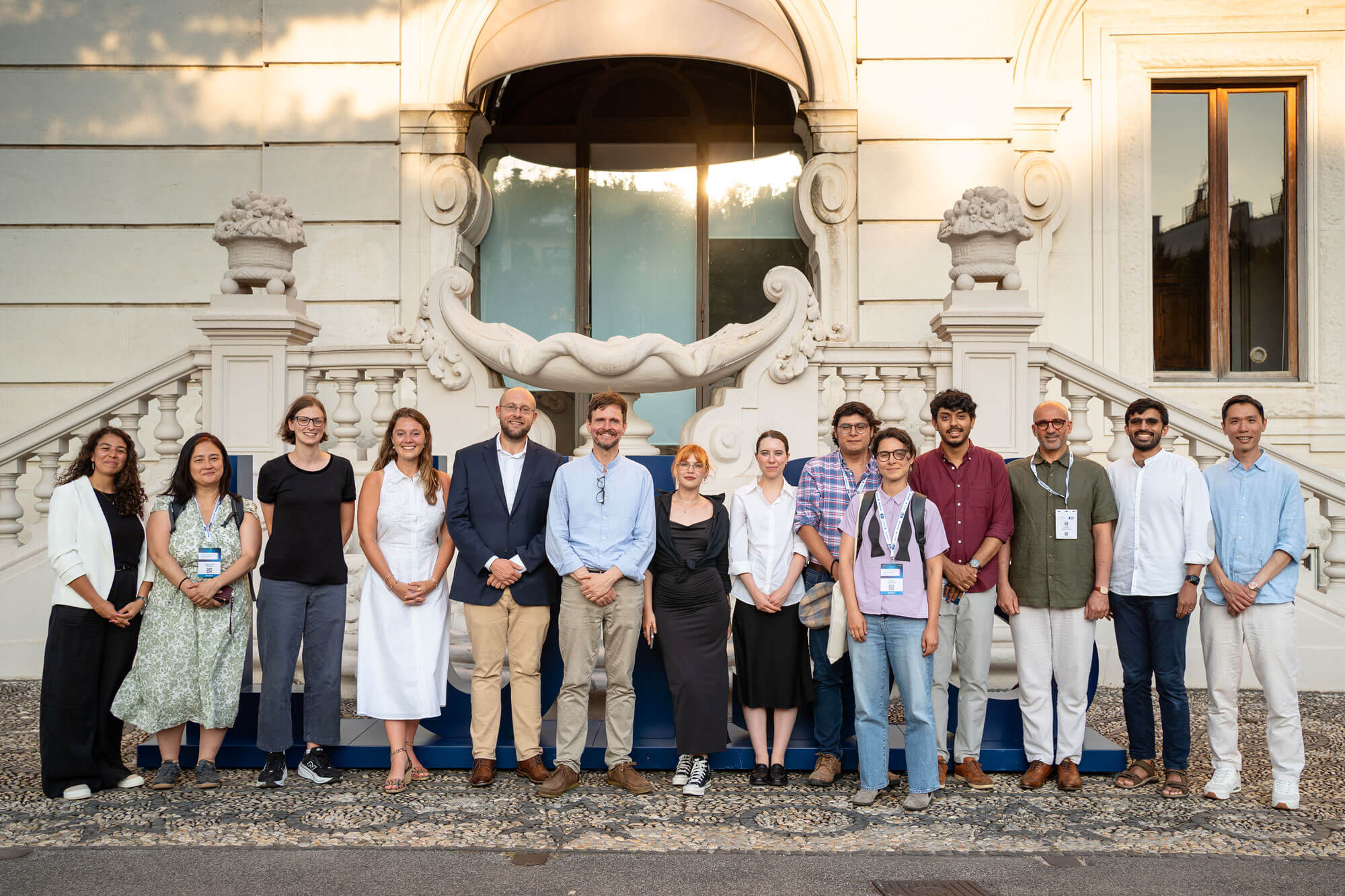
<figure class="image image-default"><img src="https://global.nd.edu/assets/671962/fullsize/rome.jpg" alt="Diverse group of 14 smiling adults in varied attire, standing before an ornate building with a large arched window." width="2000" height="1333"></figure>
<p>Participants of the 2026 <a href="https://rome.nd.edu/it/research/projects-activities/rome-summer-seminars-on-religion-and-global-politics/">Rome Summer Seminars on Religion and Global Politics</a> pose with Michael Driessen (pictured center), professor of political science and international affairs and director of the MA in international affairs at John Cabot University, who organized the program in collaboration with <a href="https://rome.nd.edu">Notre Dame Rome</a>. Drawing on Rome’s distinctive religious and geopolitical landscape, the two-week program brought together graduate students from around the world working at the crossroads of religion and global politics through public panels, expert lectures, seminars with leading international scholars and members of the diplomatic community, as well as site visits, writing workshops, and a policy dialogue. <em>Photo credit: Ansari Institute for Global Engagement with Religion, a valued partner of the Rome Summer Seminars on Religion and Global Politics.</em></p>
<hr>
<h2>MEXICO</h2>
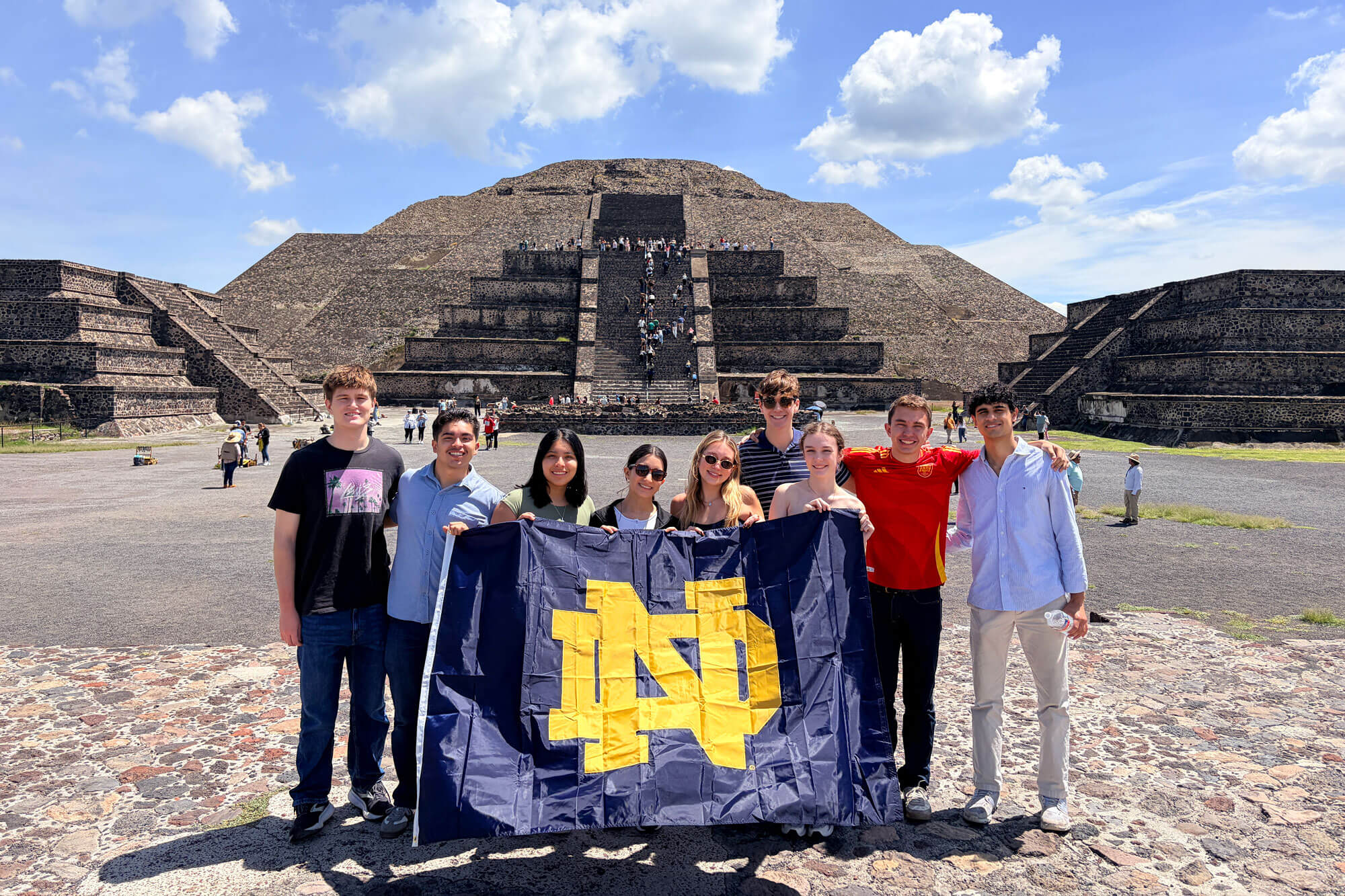
<figure class="image image-default"><img src="https://global.nd.edu/assets/671967/fullsize/mexico.jpg" alt="Eight smiling students hold a navy blue and gold Notre Dame flag in front of the Pyramid of the Sun at Teotihuacan." width="2000" height="1333"></figure>
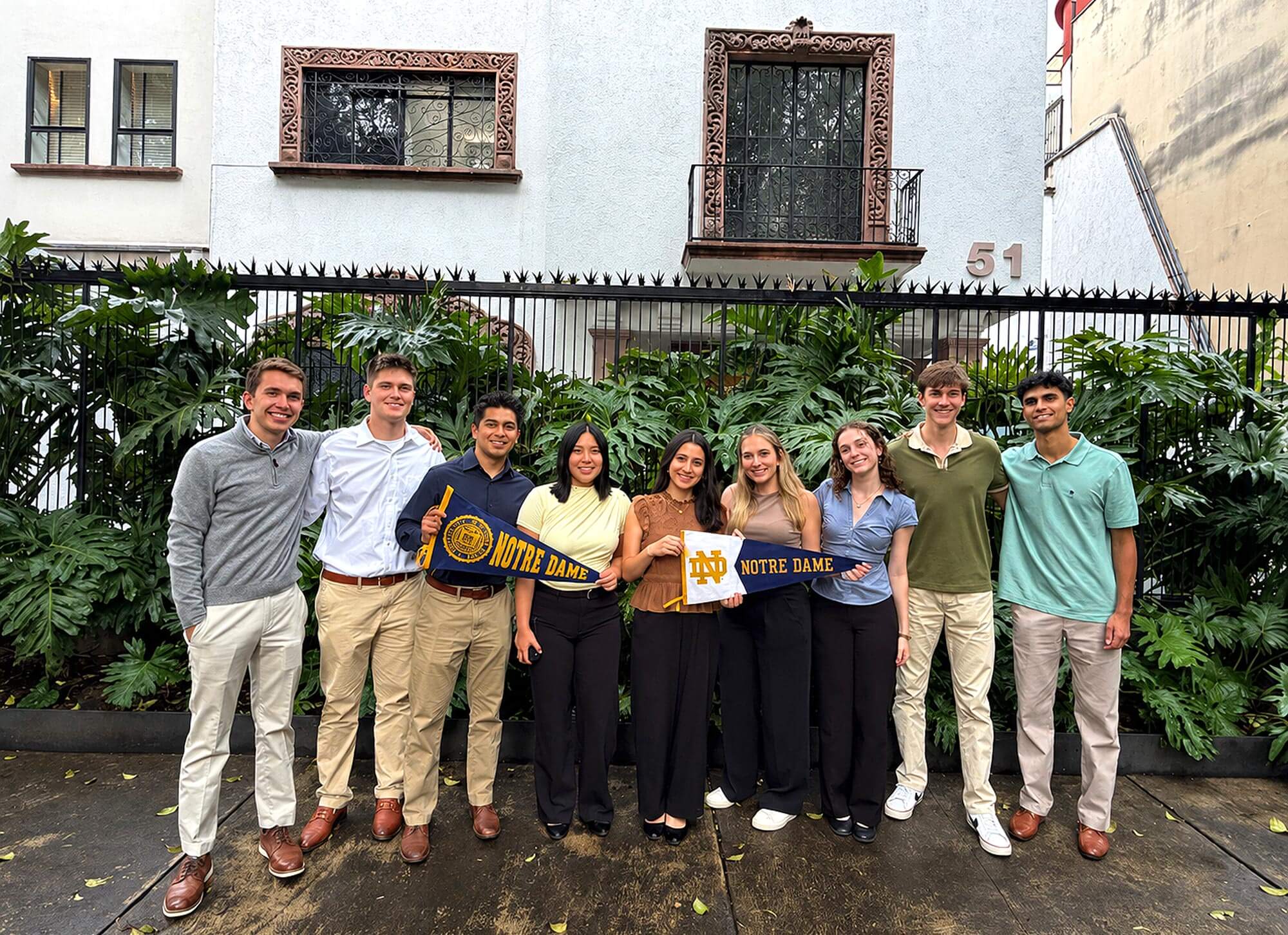
<p><a href="https://mexico.nd.edu">Notre Dame Mexico</a> concluded the 2026 <a href="https://studyabroad.nd.edu/programs/global-professional-experience-program/">Global Professional Experience</a> (GPE) and <a href="https://studyabroad.nd.edu/programs/global-research-experience-program/">Global Research Experience</a> (GRE) programs in Mexico City. Over seven weeks, students took part in a wide variety of professional and research placements at places like AmCham/Mexico, the Mexico-United States Commission for Educational and Cultural Exchange (COMEXUS), and Escuela Nacional de Ciencias Biológicas, among others—while immersing themselves in Mexico's culture and building connections with local partners and communities.</p>
<hr>
<h2>GLOBAL ENGAGEMENT PROGRAMS</h2>
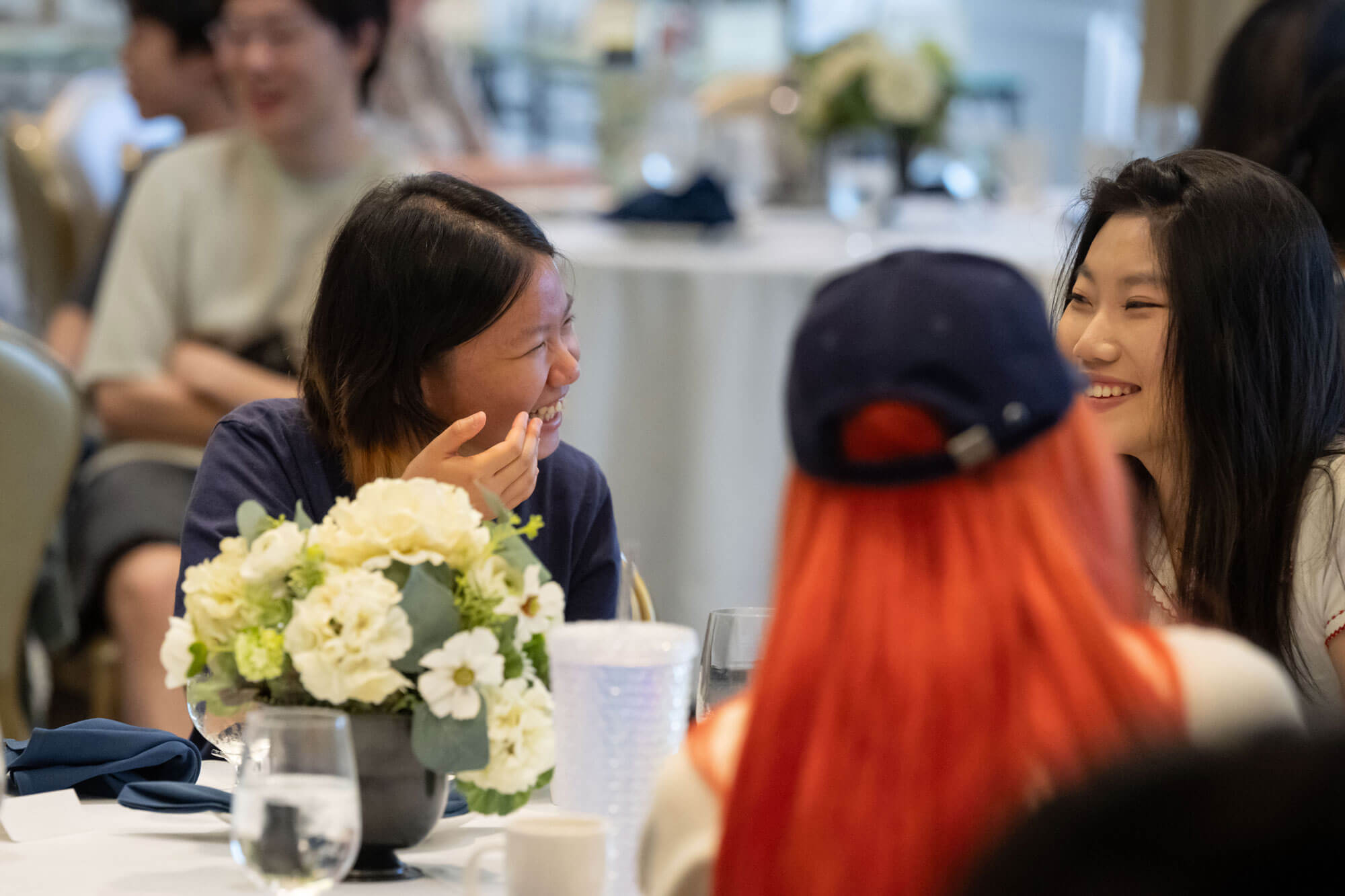
<figure class="image image-default"><img src="https://global.nd.edu/assets/671966/fullsize/gep.jpg" alt="Two young women smile and laugh while conversing at a table with white floral centerpieces at a formal event." width="2000" height="1333"></figure>
<p>The second cohort of the <a href="https://ndi-sa.nd.edu/index.cfm?FuseAction=Programs.ViewProgramAngular&amp;id=10096">International Summer Undergraduate Research Experience</a> (iSURE) program arrived in July, kicking off eight weeks of research, professional development, and community building. The group of 44 students will gain hands-on research experience, working closely with Notre Dame faculty and graduate students on a variety of projects. Through a personalized and interdisciplinary approach to mentoring and academic immersion, the iSURE program aims to nurture each student’s personal, academic, and intercultural growth throughout their time on campus. </p>
<hr>
<h2>JERUSALEM</h2>
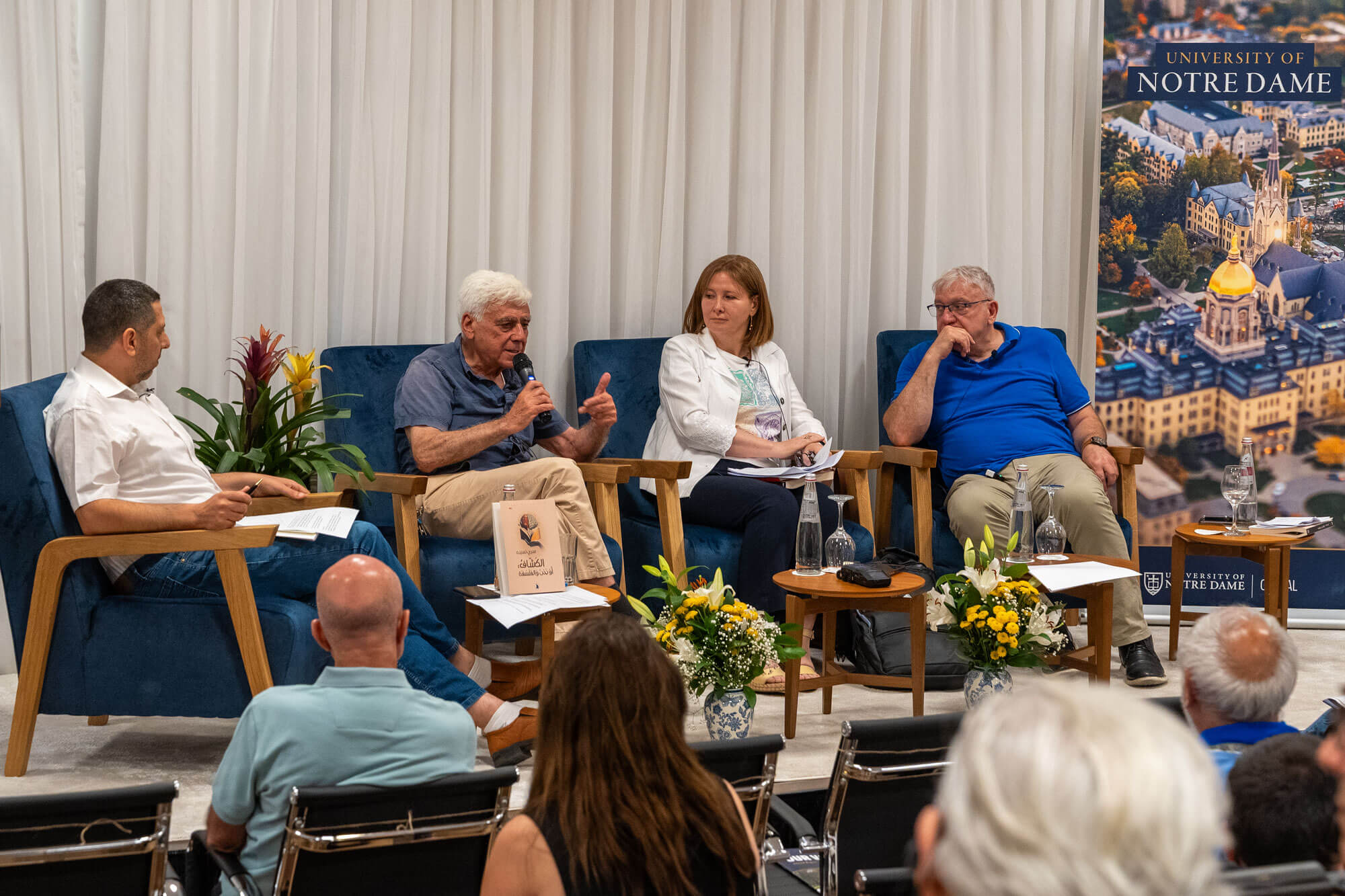
<figure class="image image-default"><img src="https://global.nd.edu/assets/671963/fullsize/jerusalem.jpg" alt="A white-haired man in a blue shirt speaks into a microphone on a panel with three others. A Notre Dame campus banner is visible." width="2000" height="1333"></figure>
<p><a href="https://jerusalem.nd.edu">Notre Dame Jerusalem</a> hosted a conversation featuring Prof. Sari Nusseibeh and other distinguished panelists during <a href="https://global.nd.edu/news-events/news/notre-dame-jerusalem-hosts-book-launch-for-professor-sari-nusseibehs-newest-book-em-the-scout-philosophy-and-us-em/">the launch</a> of <em>The Scout: Philosophy and Us, </em>which explores the practical application of philosophical thinking and methods to address deep societal challenges. </p>
<hr>
<h2>MUMBAI</h2>
<figure class="image image-default"><img src="https://global.nd.edu/assets/671965/fullsize/mumbai.jpg" alt="Eight smiling adults, including a man in a turban, hold a blue and gold Notre Dame flag in a hotel lobby." width="2000" height="1333"></figure>
<p>Notre Dame alumni, students, and parents gathered at the Novotel Hotel, Juhu, Mumbai for the annual <a href="https://mumbai.nd.edu">Notre Dame Mumbai</a> student sendoff. This year's incoming Indian students represent various parts of the country, including Bengaluru, Hyderabad, Kolkata, and Mumbai—and will pursue majors in a wide range of disciplines, including architecture, biological sciences, business, economics, environmental sciences, and physics.</p>
<hr>
<h2>BEIJING</h2>
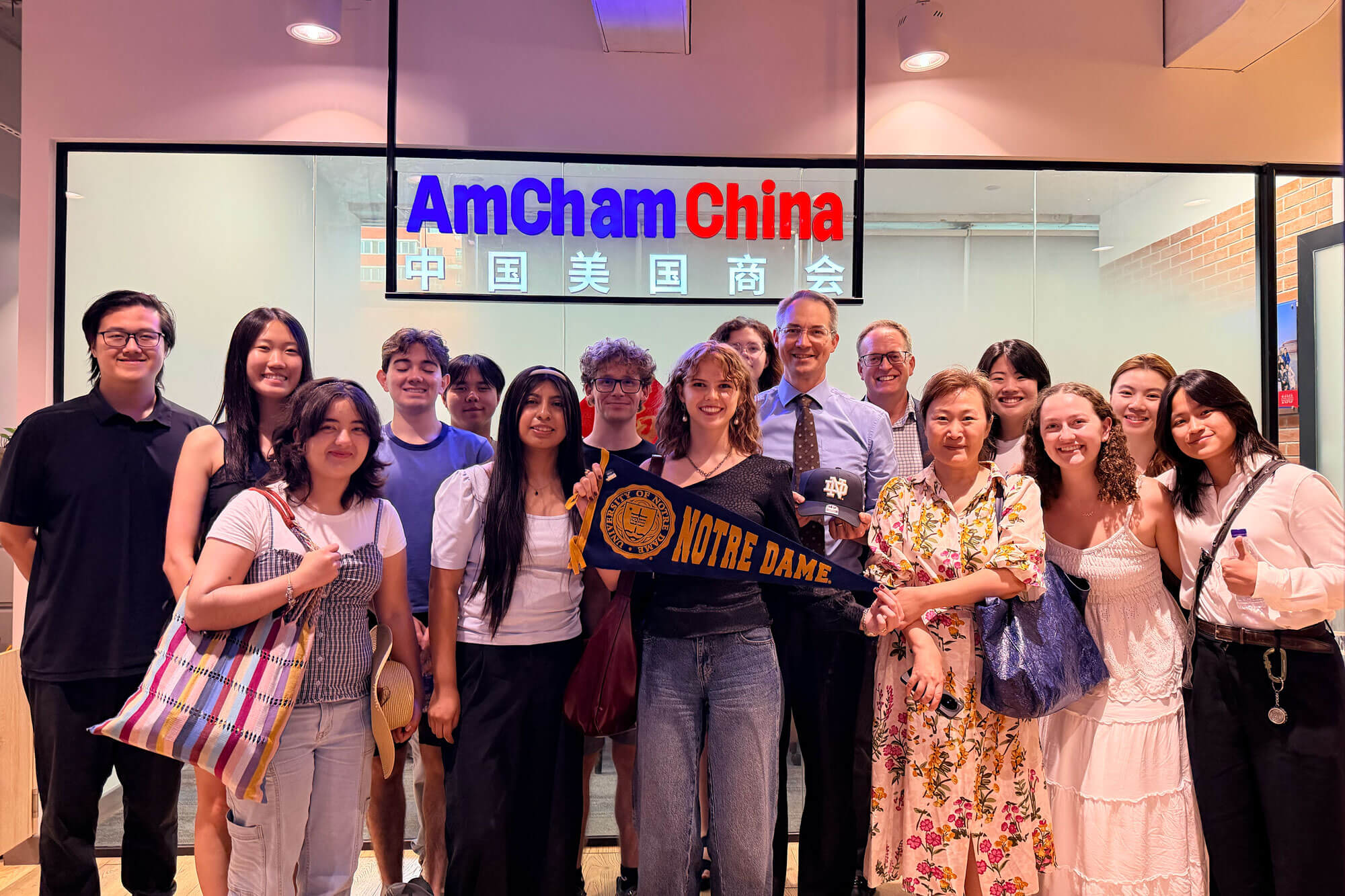
<figure class="image image-default"><img src="https://global.nd.edu/assets/671964/fullsize/beijing.jpg" alt="Smiling students and adults stand by the AmCham China sign. A woman holds a Notre Dame pennant, a man holds an ND hat." width="2000" height="1333"></figure>
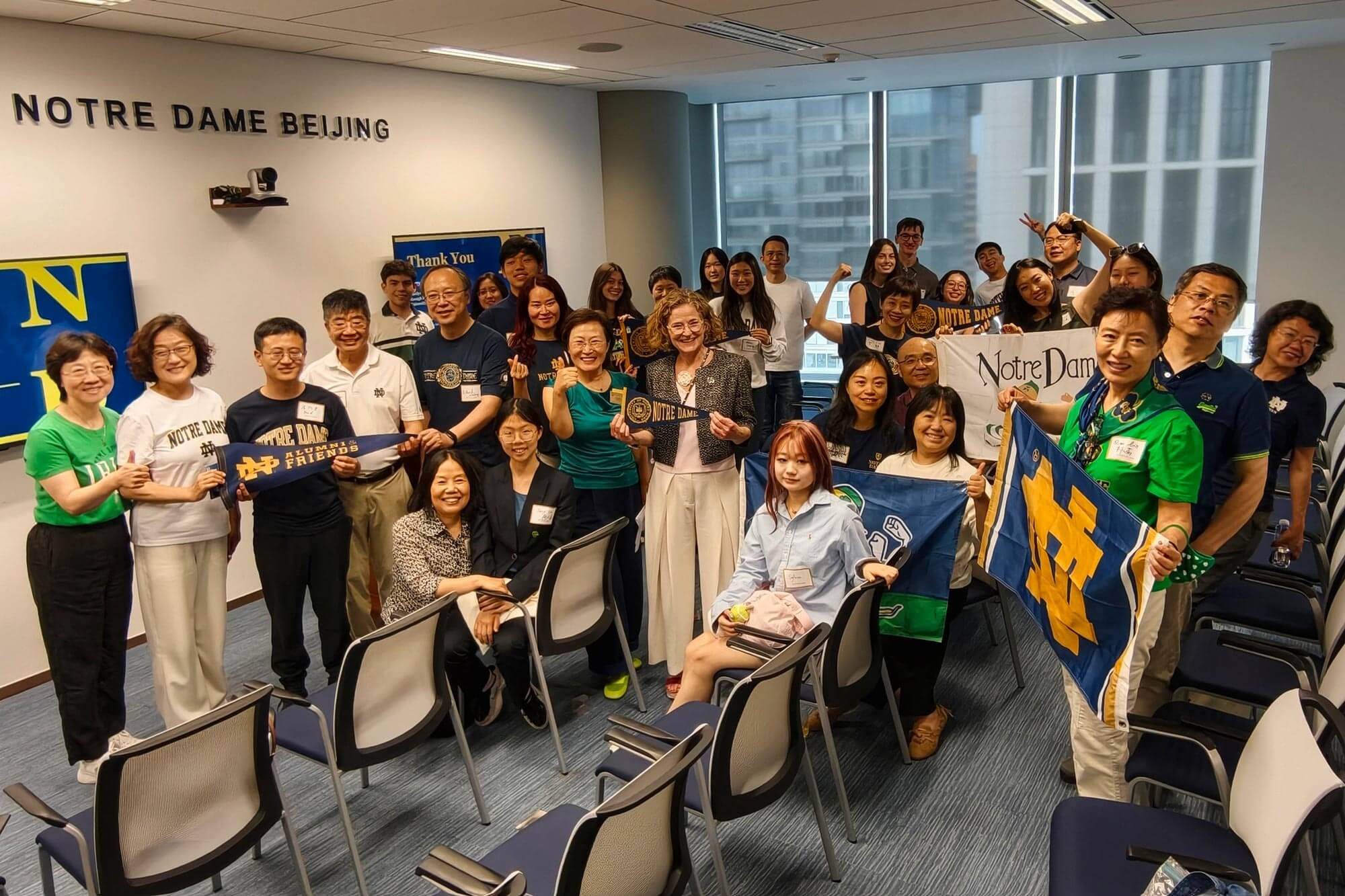
<p><a href="https://ndi-sa.nd.edu/index.cfm?FuseAction=Programs.ViewProgram&amp;Program_ID=10184">Beijing Summer</a> students visited the American Chamber of Commerce in China (AmCham China) to learn about the US-China business environment and the Chamber’s work supporting the American business community in China. Through presentations and an interactive Q&amp;A with Chamber leadership, students gained firsthand insights into business, communications, and cross-cultural engagement.</p>
<hr>
<h2>SÃO PAULO</h2>
<figure class="image image-default"><img src="https://global.nd.edu/assets/671961/fullsize/saopaulo.jpg" alt="A diverse group of smiling people standing in rows in a well-lit classroom." width="2000" height="1333"></figure>
<p>Notre Dame faculty and researchers joined colleagues from Brazilian universities for a collaborative workshop on energy and chemical conversion at IQ-UNESP in Araraquara, Brazil. The gathering brought together Notre Dame’s David Go and Edward Maginn, visiting researcher José Balena Gabriel Filho, <a href="https://saopaulo.nd.edu">Notre Dame São Paulo</a> Director Thais Burmeister Pires, and fellow researchers to exchange ideas and advance scientific collaboration.</p>
<hr>
<h2>SANTIAGO</h2>
<figure class="image image-default"><img src="https://global.nd.edu/assets/671960/fullsize/santiago.jpg" alt="Fifteen people pose smiling under a dark blue sky with many stars. Cacti grow on a rocky hill behind them." width="2000" height="2470"></figure>
<p>Students in <a href="https://santiago.nd.edu">Notre Dame Santiago</a>’s summer programs traveled to the Elqui Valley for an evening of stargazing. Known for its exceptionally clear skies and role in astronomical research, the valley offered students a chance to experience one of northern Chile’s most distinctive landscapes while learning more about the region’s connection to the night sky.</p>
<hr>
<p><em>This photo gallery highlights some of the valuable interactions and experiences Notre Dame faculty, staff, students, and alumni have taken part in over the past month. </em><em>The selection was curated by Notre Dame Global staff working on campus and in the University's <a href="https://global.nd.edu/global-network/">12 global locations</a>.</em></p>]]>
    </content>
    <link rel="enclosure" type="image/jpeg" href="https://global.nd.edu/assets/671968/dublin.jpg" title="Crowd views a wall of portraits. Prominent: woman in lemon dress, woman in black, man in green shirt facing wall."/>
    <author>
      <name>Cory Hankins</name>
    </author>
  </entry>
  <entry>
    <id>tag:global.nd.edu,2005:News/183419</id>
    <published>2026-07-29T14:10:00-04:00</published>
    <updated>2026-07-29T14:10:36-04:00</updated>
    <link rel="alternate" type="text/html" href="https://global.nd.edu/news-events/news/the-wicked-problem-of-peace/"/>
    <title>The Wicked Problem of Peace </title>
    <summary type="text">
      <![CDATA[By the time the panel closed, George A. López had been in Mexico City for a little over 24 hours—just long enough to start recognizing faces in the room at Universidad Autómoma de México’s (UNAM) Centro de Investigaciones sobre América del Norte (CISAN). But López has spent a career learning that…]]>
    </summary>
    <content type="html">
      <![CDATA[<p>By the time the panel closed, George A. López had been in Mexico City for a little over 24 hours—just long enough to start recognizing faces in the room at Universidad Autómoma de México’s (UNAM) Centro de Investigaciones sobre América del Norte (CISAN). But López has spent a career learning that peace work rarely starts with a grand gesture. It starts small: one conversation, one shared room, one day, sometimes just listening.</p>
<figure class="image image-right"><img src="https://mexico.nd.edu/assets/668222/425x/unam_lopez_story_2.jpeg" alt="Five panelists, three women and two men, are seated at a dark blue table below a screen showing four virtual participants." width="600" height="400"></figure>
<p>The Notre Dame professor was in Mexico City for the first edition of a seminar meant to become permanent: "Transnationalization of the Culture of Peace in North America.” This event was organized by UNAM's Coordinación de Humanidades together with CISAN, the Institute of Social Research, the Faculty of Psychology, the National School of Social Work, the Centro de Estudios Mexicanos UNAM in Chicago, and the University of Notre Dame.</p>
<p>López participated in the panel, “University of Notre Dame: Years of Experience in Academic Peace Culture,” moderated by María Mercedes Salmon, Notre Dame Mexico’s director. Beside him, on a screen, was Erin Corcoran, executive director of Notre Dame's <a href="https://kroc.nd.edu/">Kroc Institute for International Peace Studies</a>. This logistical arrangement reflects something about the work itself: peacebuilding across a border rarely happens only in one place at one time. Sometimes it requires meeting halfway and showing up however it’s possible.</p>
<p>Corcoran opened with the institute's origin story. Kroc was founded nearly 40 years ago, inspired by the shared vision of Father Theodore Hesburgh and its principal donor, Joan Kroc, in the shadow of the Cold War and the fear of nuclear proliferation. The earliest idea was to bring students from Cold War countries to Notre Dame to study alongside Notre Dame's own students, and see whether living and learning together could do what treaties alone could not. Peace, in those years, mostly meant the absence of violence. It took decades—and, Corcoran said, the accumulated experience of some 2,200 alumni now working in more than 100 countries—for that definition to widen into something more demanding: not just the absence of violence, but the presence of justice, reconciliation, and accountability.</p>
<figure class="image image-left"><img src="https://mexico.nd.edu/assets/668224/400x/unam_lopez_story_4.jpeg" alt="Five men meet in a blue-walled room. One man speaks, gesturing; others listen and take notes at a table with laptops." width="600" height="450"></figure>
<p>López's own memory of the institute's first year carries the same lesson. In 1986, newly recruited to help build something that didn't yet exist, he ran an open workshop for any faculty member curious about the peace institute. An architecture professor came up to him afterward, delighted to have found what he called “people of the wicked problem”—his own field's term for questions with no clean solution. He explained to López that he taught students to build houses that hold on a hillside, houses that hold in sand, and houses that survive a hurricane. What nobody teaches is how to build a house that has to do all three at once. It was at that moment that López realized that peace studies was a wicked problem. The discipline dealt with injustice, violence, and militarism, all at once, and there was no clean solution. Nevertheless, this was no excuse to stop trying.</p>
<p>Peace studies, both López and Corcoran made clear, is not what it was when Kroc began. It now reaches into migration, corruption, the violence that crosses the US-Mexico border in both directions—problems too tangled to solve one discipline at a time. López offered the frame the Keough School now teaches under: integral human development, in which peace depends as much on economic and justice systems as it does on the absence of conflict. Universities, he said, tend to think in straight lines, but peace refuses that shape. It has to be built inductively, as you go, with a lot of trial and error.</p>
<p>The same issues apply close to home. What does a university owe the community just outside its gates, at a moment when violence is everywhere? Corcoran was unsentimental about it: Notre Dame doesn't sit on a hill in South Bend. Students don't need to travel abroad to see conflict or poverty—they can walk two miles down the street. López's answer was smaller still, and somehow more hopeful: tell whatever small stories of peace you have, and say them out loud. A reconciled friendship. A council that finally agreed to talk. Peace, he said, is not waiting to be found. It has to be created, one small anecdote at a time.</p>
<p>It is exactly that widened understanding of peace—built across disciplines and in every aspect of our daily life, tested against real violence—that Notre Dame brought into the room in Mexico City. And it is exactly what UNAM has been striving towards through PUCPAZ, UNAM's Programa Universitario sobre Cultura de Paz y Erradicación de las Violencias (University Program on the Culture of Peace and the Eradication of Violence).</p>
<figure class="image image-right"><img src="https://mexico.nd.edu/assets/668223/400x/unam_lopez_story_3.jpeg" alt="Maria Mercedes Salmon and George Lopez present at a CISAN panel. A Mexican flag stands nearby and online participants are on screen." width="600" height="577"></figure>
<p>The program, launched by UNAM's Coordinación de Humanidades, aims to counter the violence experienced across the country, particularly within the high school system. PUCPAZ rests on three pillars: mediation, gender perspective, and human rights. According to the director, peace is not the absence of conflict but a different way of resolving it, one where social violence is not the only option communities reach for when they disagree.</p>
<p>The Kroc Institute has spent nearly 40 years learning exactly what PUCPAZ is only beginning to discover: not just how to teach peace, but how to build an institution capable of teaching it well, semester after semester. Under López's own direction, Kroc's Summer Institute on Teaching Peace spent over a decade helping more than 100 universities across five continents go from wanting a peace studies program to actually having one. That is the collaboration this first seminar was quietly built to start.</p>
<p>María Mercedes Salmon closed the panel by thanking Corcoran and López for sharing not just their expertise but also their struggles. What had happened in that room, she said, was the start of exactly what PUCPAZ had asked for: two universities agreeing to keep teaching each other. The next exchange is planned for the end of the year. For an institution built on the conviction that peace moves forward one step at a time, the seminar had the only kind of ending that made sense. It was not a conclusion, but the first step of a much longer road the two universities will walk together.</p>
<p class="attribution">Originally published by <span class="rel-author">Norma Sofia Rivera Padilla</span> at <span class="rel-source"><a href="https://mexico.nd.edu/news-stories/news/the-wicked-problem-of-peace/">mexico.nd.edu</a></span> on <span class="rel-pubdate">July 29, 2026</span>.</p>]]>
    </content>
    <link rel="enclosure" type="image/jpeg" href="https://global.nd.edu/assets/668273/unam_lopez_story_1.jpeg" title="George Lopez, Anel Perez Martinez, and three others on a panel, with a Mexican flag and a speaker addressing an audience."/>
    <author>
      <name>Norma Sofia Rivera Padilla</name>
    </author>
  </entry>
  <entry>
    <id>tag:global.nd.edu,2005:News/183351</id>
    <published>2026-07-27T08:07:15-04:00</published>
    <updated>2026-07-27T08:07:15-04:00</updated>
    <link rel="alternate" type="text/html" href="https://global.nd.edu/news-events/news/pivoting-toward-justice/"/>
    <title>Pivoting toward justice</title>
    <summary type="text">
      <![CDATA[Students embark on summer research for the common good July 22, 2026   This summer, the Institute for Social Concerns…]]>
    </summary>
    <content type="html">
      <![CDATA[<h2 class="wp-block-heading"><strong>Students embark on summer research for the common good</strong></h2>
<h4 class="wp-block-heading">July 22<strong>, 202</strong>6</h4>
<div class="wp-block-spacer" aria-hidden="true"> </div>
<p>This summer, the <a><strong>Institute for Social Concerns</strong></a> placed 332 Notre Dame students with 150 partner organizations through its celebrated summer programs. Students spent the spring semester preparing for immersive summer experiences from New York to San Francisco, Belfast to Mumbai, where they would spend eight weeks conducting original research while engaging with local communities.</p>
<figure class="wp-block-image size-large"><img class="wp-image-25079" src="https://socialconcerns.nd.edu/wp-content/uploads/2026/07/Amelia-Lim_1-scaled-e1784904797778-1024x683.jpg" sizes="(max-width: 1024px) 100vw, 1024px" srcset="https://socialconcerns.nd.edu/wp-content/uploads/2026/07/Amelia-Lim_1-scaled-e1784904797778-1024x683.jpg 1024w, https://socialconcerns.nd.edu/wp-content/uploads/2026/07/Amelia-Lim_1-scaled-e1784904797778-300x200.jpg 300w, https://socialconcerns.nd.edu/wp-content/uploads/2026/07/Amelia-Lim_1-scaled-e1784904797778-768x512.jpg 768w, https://socialconcerns.nd.edu/wp-content/uploads/2026/07/Amelia-Lim_1-scaled-e1784904797778-1536x1024.jpg 1536w, https://socialconcerns.nd.edu/wp-content/uploads/2026/07/Amelia-Lim_1-scaled-e1784904797778-600x400.jpg 600w, https://socialconcerns.nd.edu/wp-content/uploads/2026/07/Amelia-Lim_1-scaled-e1784904797778.jpg 1920w" alt="" width="1024" height="683">
<figcaption class="wp-element-caption"><em>Amelia Lim ’29 (right) accompanies child to aquarium in Chennai, India</em></figcaption>
</figure>
<p>But when an Ebola outbreak gripped communities across East Africa, closing the region to outside visitors, 22 of these students saw their initial research plans evaporate.</p>
<p>Rather than abandoning their summer research, these students embraced a sudden pivot. Leveraging the institute’s decades of deeply rooted global and domestic partnerships, the students stepped into entirely new, unfamiliar environments—reframing their academic lenses to meet the unique needs of their new host communities.</p>
<h4 class="wp-block-heading">Designing architecture for a new climate in Chuuk, Micronesia</h4>
<p>For architecture major Wesley Buonerba ’27, the sudden change meant trading a plane ticket to Kenya for a journey to the remote island of Weno in Chuuk, Micronesia. Originally set to document Swahili building traditions in East Africa through a <a><strong>Summer Fellowship</strong></a>, Wesley adapted his research focus to the intense heat and heavy equatorial rains of the Pacific, studying how traditional Micronesian building practices cultivate essential vocational skills.</p>
<p>Wesley found a welcoming home at Xavier High School, a first-time partner organization for the institute. Along with teaching at the school and conducting his own research, Wesley found an unexpected opportunity for unique interdisciplinary collaboration.</p>
<figure class="wp-block-image size-large"><img class="wp-image-25078" src="https://socialconcerns.nd.edu/wp-content/uploads/2026/07/Wesley-Buonerba_1-scaled-e1784905115384-1024x683.jpeg" sizes="(max-width: 1024px) 100vw, 1024px" srcset="https://socialconcerns.nd.edu/wp-content/uploads/2026/07/Wesley-Buonerba_1-scaled-e1784905115384-1024x683.jpeg 1024w, https://socialconcerns.nd.edu/wp-content/uploads/2026/07/Wesley-Buonerba_1-scaled-e1784905115384-300x200.jpeg 300w, https://socialconcerns.nd.edu/wp-content/uploads/2026/07/Wesley-Buonerba_1-scaled-e1784905115384-768x512.jpeg 768w, https://socialconcerns.nd.edu/wp-content/uploads/2026/07/Wesley-Buonerba_1-scaled-e1784905115384-1536x1024.jpeg 1536w, https://socialconcerns.nd.edu/wp-content/uploads/2026/07/Wesley-Buonerba_1-scaled-e1784905115384-2048x1366.jpeg 2048w, https://socialconcerns.nd.edu/wp-content/uploads/2026/07/Wesley-Buonerba_1-scaled-e1784905115384-600x400.jpeg 600w" alt="" width="1024" height="683">
<figcaption class="wp-element-caption"><em>Wesley Buonerba ’27 (right) helps local residents with construction project in Chuuk, Micronesia</em></figcaption>
</figure>
<p>Rerouted with two other fellowship students, Jack Keller ’27, an electrical engineering and theology major, and David Nagy ’28, a PLS and psychology major with a minor in sustainability, Wesley found that the serendipitous confluence of their backgrounds in engineering, architecture, and sustainability allowed the trio to assist in the construction of a new building on the school’s campus.</p>
<p>“The experience here in Chuuk has almost been more compatible with my proposed research question,” Wesley shares. “Xavier afforded me not only the opportunity to teach in the classroom for a month but also the chance to practice construction in one of the world’s most remote environments. I’ve been able both to see how houses are constructed here in Chuuk and to participate in construction, gaining further insight into the state of the industry along the way.”</p>
<h4 class="wp-block-heading">Learning to trust the pivot in Chennai, India</h4>
<p>Rising sophomore Amelia Lim ’29 experienced a similar whirlwind transition. A psychology and finance major, she was set to work with a vocational school for vulnerable youth in Uganda through the <a><strong>NDBridge</strong></a> program before receiving news of the outbreak.</p>
<p>Amelia was rerouted to Chennai, India, where she joined a cohort of four NDBridge “podmates” working with Vidya Sagar, an organization providing therapy and vocational training to over 3,800 individuals with disabilities each year.</p>
<h3 class="wp-block-heading">“Looking back, what started as a stressful disruption turned out to be the ultimate blessing. It has taught me to trust the pivot.”</h3>
<h4 class="wp-block-heading">– Amelia Lim ’29, psychology and finance major</h4>
<div class="wp-block-spacer" aria-hidden="true"> </div>
<p>There she quickly realized her background in psychology and finance could be leveraged to examine complex questions of institutional equity and systemic barriers to independence. She adjusted her research on the ground to focus on sensory integration in classrooms with varying neurodevelopmental and physical needs.</p>
<p>“Each day, I get to encounter the fierce, unfiltered, childlike joy of the students I’m working with,” Amelia reflects. “Looking back, what started as a stressful disruption turned out to be the ultimate blessing. It has taught me to trust the pivot.”</p>
<h4 class="wp-block-heading">Redefining public health on the street in Jackson, Mississippi</h4>
<p>Rachael Vu ’28, a neuroscience and behavior major, was originally prepared to spend her Summer Fellowship at a large public hospital in Mumbai, India. When travel plans shifted due to complications procuring her visa, she found her clinical research question localized at Stewpot Community Services in Jackson, Mississippi.</p>
<div class="wp-block-image">
<figure class="alignright size-large"><img class="wp-image-25080" src="https://socialconcerns.nd.edu/wp-content/uploads/2026/07/IMG_0264-Rachael-Vu-768x1024.jpg" sizes="(max-width: 768px) 100vw, 768px" srcset="https://socialconcerns.nd.edu/wp-content/uploads/2026/07/IMG_0264-Rachael-Vu-768x1024.jpg 768w, https://socialconcerns.nd.edu/wp-content/uploads/2026/07/IMG_0264-Rachael-Vu-225x300.jpg 225w, https://socialconcerns.nd.edu/wp-content/uploads/2026/07/IMG_0264-Rachael-Vu-1152x1536.jpg 1152w, https://socialconcerns.nd.edu/wp-content/uploads/2026/07/IMG_0264-Rachael-Vu.jpg 1536w" alt="" width="768" height="1024" loading="lazy">
<figcaption class="wp-element-caption"><em>Rachael Vu ’28 (left) works with street outreach team on public health in Jackson, Mississippi</em></figcaption>
</figure>
</div>
<p>Instead of shadowing physicians in a referral center, Rachael found herself joining street outreach teams, walking narrow wooded paths in Jackson to deliver supplies directly to hidden encampments of unhoused residents.</p>
<p>“Interacting with community members in this setting made me realize the profound impact of being a consistent, familiar presence,” Rachael explains. “It taught me that effective public health is not just about checking clinical numbers but about earning trust and providing a reliable sense of continuity for people navigating difficult circumstances.”</p>
<p>Across three continents, these students experienced how trusting the pivot means embracing new contexts for research as opportunities for genuine human encounter. For <a><strong>Emily Garvey</strong></a>, associate director of justice education, these transformations illustrate the core of what the institute’s summer programs aim to cultivate.</p>
<p>“The resilience and adaptability these students have shown after their plans were upended are part of what it means to pursue the common good,” Garvey reflects. “It’s about looking past the disruption and focusing on the human being right in front of you.”</p>]]>
    </content>
    <link rel="enclosure" type="image/jpeg" href="https://global.nd.edu/assets/667889/amelia_lim_1.jpg" title="Amelia Lim ’29 (right) accompanies child to aquarium in Chennai, India"/>
    <author>
      <name>David Cramer</name>
    </author>
  </entry>
  <entry>
    <id>tag:global.nd.edu,2005:News/183137</id>
    <published>2026-07-16T08:17:00-04:00</published>
    <updated>2026-07-16T08:19:19-04:00</updated>
    <link rel="alternate" type="text/html" href="https://global.nd.edu/news-events/news/notre-dame-jerusalem-hosts-book-launch-for-professor-sari-nusseibehs-newest-book-em-the-scout-philosophy-and-us-em/"/>
    <title>Notre Dame Jerusalem hosts book launch for Prof. Sari Nusseibeh's newest book, &lt;em&gt;The Scout: Philosophy and Us&lt;/em&gt;</title>
    <summary type="text">
      <![CDATA[Dr. Daniel Schwake, ND Jerusalem Director, introduces and welcomes…]]>
    </summary>
    <content type="html">
      <![CDATA[<figure class="image image-right"><img src="https://jerusalem.nd.edu/assets/666427/375x/copy_of_dsc04397.jpg" alt="A smiling man in a suit holding a mic shakes hands with an older man in a blue shirt at a Notre Dame event.">
<figcaption>Dr. Daniel Schwake, ND Jerusalem Director, introduces and welcomes Prof. Sari Nusseibeh.</figcaption>
</figure>
<p>On July 1, <a href="https://jerusalem.nd.edu/">Notre Dame Jerusalem</a> hosted the launch of <em>The Scout: Philosophy and Us</em>, a new book by Professor Sari Nusseibeh, a faculty member at the academic center. Held on the Tantur campus, the event welcomed more than 100 guests and brought together academics, students, and members of the wider community to celebrate the publication.</p>
<p>Moderated by Mahmoud Muna from the <a href="https://educationalbookshop.com/">Educational Bookshop</a> in Jerusalem, the panel brought together leading voices in philosophy and education, including Sari Nusseibeh; Professor Raef Zreik, senior research fellow at the <a href="https://www.vanleer.org.il/">Van Leer Institute</a>; and Dr. Rodayna Ghanim, principal of Yamma Agricultural High School. Presented in Arabic with simultaneous English translation, the discussion explored the role of philosophy in everyday life and personal interactions.</p>
<blockquote>
<h4>“The book does not claim to provide solutions; it suggests that we need to think together, speak with each other, and create spaces where people can discuss what concerns them.”</h4>
</blockquote>
<p>The evening started with remarks from Dr. Daniel Schwake, director of Notre Dame Jerusalem, who discussed the key question behind Nusseibeh’s latest work: whether philosophy can help us tackle the social, educational, political, and ethical issues of today. Schwake clarified that the book is not about exploring individual philosophers' ideas but about examining whether philosophy itself can help us become better thinkers, citizens, and perhaps better humans. He described Nusseibeh’s book as “revolutionary” because it promotes ethical behavior not just as a moral duty but as an essential part of critical thinking. It is a “sufficient requirement.” Schwake also added, “This point is especially vital now, with the rise of AI. AI can produce and summarize a book instantly, but cannot replace what we have here tonight—an interaction between humans. Nusseibeh shows us that to leave this room with just a little more knowledge, all we need is mutual respect.”</p>
<p>Raef Zreik began by sharing his thoughts on <em>The Scout</em>, describing it as an elegant and accessible book that encourages readers to question rather than seek certainty. He referred to the book as "a satire of certainty and a praise of questioning," fostering philosophical inquiry in scientific and ethical discussions. Zreik emphasized one of the main ideas, mentioning Nusseibeh's view that the complexity of Israel's situation helps us understand ethical thinking better, instead of just applying ethical judgments. He also noted that the book criticizes superficial public discourse and urges deeper reflection, tying its approach to philosophical traditions that emphasize clarification and engagement with core human questions.</p>
<p>Rodayna Ghanim followed Zreik, connecting the book’s concepts to her own work in philosophy education and her efforts to bring philosophy beyond the traditional academic setting. She praised Nusseibeh’s approach of presenting philosophy through everyday examples, making philosophical thinking accessible to students and communities. “When I began reading the book, I did not feel that I was reading a traditional philosophy book,” Ghanim said. “At its heart, it is a defense of the human being who has not lost the courage to ask questions and who refuses to live inside ready-made answers.”</p>
<p>She highlighted the connection between philosophy and education, arguing that critical thinking should not be viewed merely as an academic skill but as a way of living. “The real challenge in education is not only what students know, but how they think, how they listen, and how they respond when they encounter someone who disagrees with them,” she said.</p>
<figure class="image image-default"><img src="https://jerusalem.nd.edu/assets/666426/950x/copy_of_dsc04297_cropped.jpg" alt="A man in a blue shirt with white hair speaks into a mic at a panel for Notre Dame at Tantur. Three other panelists listen intently." width="950" height="453">
<figcaption>Prof. Sari Nusseibeh dicsusses his book along with panelists (from left to right), Mahmound Muna, Dr. Rodayna Ghanim, and Prof. Raef Zreik.</figcaption>
</figure>
<p>Nusseibeh concluded the panel discussion by reflecting on the experiences that shaped the book. Responding to questions about why he wrote the book, Nusseibeh explained that much of his inspiration came from decades of teaching and learning from students. “I came to teach after completing my doctorate, but year after year I discovered that I was not only teaching, I was also learning,” he said.</p>
<p>Nusseibeh described Palestinian society as living in a kind of “escape room,” where people face multiple challenges yet often struggle to identify the shared questions that must be solved together. “In an escape room, people need to work together to solve one puzzle after another until they find the way out,” he explained. “If they spend their time fighting with each other, they will never find the solution.” He emphasized that the purpose of philosophy is not to provide simple answers but to encourage people to ask better questions and create spaces for dialogue. “The book does not claim to provide solutions,” Nusseibeh said. “It suggests that we need to think together, speak with each other, and create spaces where people can discuss what concerns them.”</p>
<p>As Schwake noted in his opening remarks, the evening was not something that AI could have generated, but an intellectually stimulating, genuine, and humane encounter. To underscore that point, the panel discussion was followed by a lively Q&amp;A session with the audience, and many of the guests remained for the reception in the garden of Tantur, lingering to continue the conversations sparked during the panel discussion.</p>
<hr>
<figure class="image image-left"><img src="https://jerusalem.nd.edu/assets/666431/450x/copy_of_dsc04261.jpg" alt="A diverse audience of adults sits attentively in rows at an indoor event. A large topographical map hangs on the wall." width="450" height="300">
<figcaption>Audience members listening to the panel discussion.</figcaption>
</figure>
<div>
<figure class="image image-left"><img src="https://jerusalem.nd.edu/assets/666430/450x/copy_of_dsc04513.jpg" alt="A lively outdoor night reception in a lit garden with many people mingling around tables with blue tablecloths." width="450" height="300">
<figcaption>Event attendees mingle during the evening reception.</figcaption>
</figure>
</div>
<hr>
<p>Watch <a href="https://youtu.be/HbDjYlF47EM">this video conversation</a> between Sari Nusseibeh, Avraham Burg, and Daniel Schwake for more information about the book and the <a href="https://jerusalem.nd.edu/outreach-engagement/the-scout-podcast/">podcast series The Scout</a>, that covered its content in English.</p>
<p class="attribution">Originally published by <span class="rel-author">Notre Dame Jerusalem</span> at <span class="rel-source"><a href="https://jerusalem.nd.edu/news-stories/news/notre-dame-jerusalem-hosts-book-launch-for-professor-sari-nusseibehs-newest-book-em-the-scout-philosophy-and-us-em/">jerusalem.nd.edu</a></span> on <span class="rel-pubdate">July 15, 2026</span>.</p>]]>
    </content>
    <link rel="enclosure" type="image/jpeg" href="https://global.nd.edu/assets/666499/copy_of_dsc04297.jpg" title="Four panelists at the University of Notre Dame at Tantur. A white-haired man in blue shirt speaks into a microphone."/>
    <author>
      <name>Notre Dame Jerusalem</name>
    </author>
  </entry>
  <entry>
    <id>tag:global.nd.edu,2005:News/183102</id>
    <published>2026-07-15T08:02:18-04:00</published>
    <updated>2026-07-15T08:02:18-04:00</updated>
    <link rel="alternate" type="text/html" href="https://global.nd.edu/news-events/news/indias-immunization-program-reduced-child-mortality-but-highlights-need-for-coordinating-health-education-policies/"/>
    <title>India’s immunization program reduced child mortality but highlights need for coordinating health, education policies</title>
    <summary type="text">
      <![CDATA[Research from the University of Notre Dame shows how India’s immunization program saved children’s lives and highlights the need for stronger connections between health and education policies.]]>
    </summary>
    <content type="html">
      <![CDATA[<figure class="image image-right"><img src="https://keough.nd.edu/assets/666230/vaccinations_feature.jpg" alt="A child receives a vaccine at a clinic in eastern India." width="600" height="338">
<figcaption>A child receives a vaccine at a clinic in eastern India. Notre Dame research finds that the country’s immunization program reduced child deaths and highlights the need to coordinate health and education policies. Photo credit: <a href="https://www.flickr.com/photos/14214150@N02/8380317750">DFID/UK Department for International Development</a>.</figcaption>
</figure>
<p>Each year, approximately 700,000 children worldwide die from diseases that vaccines could have prevented, nearly all of them in low- and middle-income countries. New research from University of Notre Dame economist <a href="https://keough.nd.edu/about/faculty-staff-directory/santosh-kumar/">Santosh Kumar Gautam</a> finds that India’s national childhood immunization program helped address this persistent global health challenge, producing substantial reductions in child deaths.</p>
<p>The study, published in the <a href="https://doi.org/10.1007/s00148-026-01186-8">Journal of Population Economics</a>, also found that the immunization program had mixed long-term effects on educational attainment. While exposure to the program reduced primary school completion, it increased secondary school completion, suggesting that improvements in child survival can influence education through multiple pathways. Findings underscore the importance of coordinating health and education policies so that gains in child survival are matched by investments in schools and learning.</p>
<p>“Vaccines are one of the most cost-effective investments a country can make in improving child health and human capital,” said Gautam, professor of development and global health economics at Notre Dame’s <a href="https://keough.nd.edu/">Keough School of Global Affairs</a>. “I wanted to understand not only how India's immunization program saved lives, but also how it affected educational trajectories and human capital development.”</p>
<h2>An experiment that reduced infant mortality</h2>
<p>India launched its Universal Immunization Programme in 1985 and implemented it district by district, reaching full national coverage by 1990. Because some districts received the program years before others, and because only children under age 1 were eligible for the vaccines, Gautam was able to compare children born just before and just after the program arrived in their district.</p>
<p>Drawing on a national survey of nearly 900,000 children, Gautam found that the program reduced infant mortality by 0.4 percentage points and under-five mortality by 0.5 percentage points — substantial gains at a time when nearly 1 in 10 infants died before their first birthday.</p>
<p>Those mortality gains were concentrated among children in rural areas, from poor households and from historically disadvantaged caste groups. Children from wealthier, urban or higher-caste households saw little change, Gautam said. This may be because many already had access to vaccination before the program arrived.</p>
<h2>Mixed educational outcomes</h2>
<p>The study also found nuanced effects on educational attainment. While the immunization program reduced primary school completion, it increased secondary school completion among surviving children.</p>
<p>Gautam said the results may reflect who survived because of the program. Some children who benefited from vaccination may not have reached school age otherwise; and, as a group, they tended to have poorer underlying health. That change in the student population may have lowered average primary school completion rates.</p>
<p>Meanwhile, children who would have survived regardless but were healthier because of vaccination were more likely to complete secondary school. Strained school infrastructure may also have reinforced the pattern, Gautam said. A sudden increase in surviving children can crowd classrooms and stretch already limited resources, particularly in the early grades.</p>
<h2>Designing health and education policy together</h2>
<figure class="image image-right"><img src="https://news.nd.edu/assets/666300/santosh_gautam_new.jpeg" alt="Man in a charcoal grey pinstripe suit jacket, black shirt, and dark-framed glasses, looking forward." width="389" height="339">
<figcaption>Notre Dame economist Santosh Kumar Gautam researches how investments in early child and maternal health can reduce poverty and help people thrive.</figcaption>
</figure>
<p>Ultimately, Gautam said, the research shows health and education investments work best when they are planned holistically rather than treated as unrelated priorities.</p>
<p>“This study illustrates how health and education planners can strengthen their coordination and produce better outcomes by working together,” Gautam said. “In addition to focusing on saving lives, governments should design policies that follow children into the classroom.”</p>
<p>The study also challenges the assumption that large public health campaigns in developing countries are inevitably undermined by weak implementation, Gautam said. Despite documented problems with medical absenteeism and service delivery in India’s health system, the program still produced a measurable reduction in child deaths.</p>
<p>The research contributes to Gautam’s broader work as an economist who studies how investments in early child and maternal health can reduce poverty and help people thrive. It is particularly relevant for resource-constrained settings, where smarter policy design is critical to improving outcomes amid limited funding.</p>
<p>“Effective immunization policy requires measuring not only who vaccines protect, but also how they shape broader human capital and support the best use of scarce public resources,” Gautam said.</p>
<p>A development and global health economics expert at Notre Dame, Gautam is the director of doctoral studies for the Keough School’s <a href="https://keough.nd.edu/academics/phd-program/ph-d-in-sustainable-development/">Ph.D. in Sustainable Development</a> and directs the <a href="https://keough.nd.edu/academics/master-of-global-affairs/concentrations/sustainable-development/">sustainable development major</a> in the school’s <a href="https://keough.nd.edu/academics/master-of-global-affairs/">Master of Global Affairs</a> program. He is an affiliate of Notre Dame’s <a href="https://globalhealth.nd.edu/">Eck Institute for Global Health</a> and the <a href="https://biglab.nd.edu/">Building Inclusive Growth (BIG) Lab </a>(part of the Keough School’s <a href="https://pulte.nd.edu/">Pulte Institute for Global Development</a>) and a faculty fellow at the Keough School’s <a href="https://kellogg.nd.edu/">Kellogg Institute</a>.</p>
<p>The study received open access funding from the University of Notre Dame’s <a href="https://www.library.nd.edu/">Hesburgh Libraries</a>.</p>
<p class="attribution">Originally published by <span class="rel-author">Josh Stowe</span> at <span class="rel-source"><a href="https://keough.nd.edu/news-and-events/news/indias-immunization-program-reduced-child-mortality-but-highlights-need-for-coordinating-health-education-policies/">keough.nd.edu</a></span> on <span class="rel-pubdate">July 14</span>.</p>
<p class="attribution"><strong><em>Media Contact</em></strong><em>: Tracy DeStazio, associate director of media relations, 574-631-9958 or </em><a href="mailto:tdestazi@nd.edu"><em>tdestazi@nd.edu</em></a></p>]]>
    </content>
    <link rel="enclosure" type="image/jpeg" href="https://global.nd.edu/assets/666352/vaccinations_feature.jpg" title="A child receives a vaccine at a clinic in eastern India."/>
    <author>
      <name>Josh Stowe</name>
    </author>
  </entry>
  <entry>
    <id>tag:global.nd.edu,2005:News/183105</id>
    <published>2026-07-14T08:08:00-04:00</published>
    <updated>2026-07-15T08:08:37-04:00</updated>
    <link rel="alternate" type="text/html" href="https://global.nd.edu/news-events/news/researchers-show-how-early-rna-based-life-may-have-repaired-its-genome-providing-insight-into-the-origins-of-life/"/>
    <title>Researchers show how early RNA-based life may have repaired its genome, providing insight into the origins of life</title>
    <summary type="text">
      <![CDATA[In a study published in Nature Communications, Saurja DasGupta, a biochemist at the University of Notre Dame, and colleagues present a key mechanism for sustaining RNA-based life: an engineered enzyme that selectively recognizes and repairs broken RNA.]]>
    </summary>
    <content type="html">
      <![CDATA[<p>In most modern cells, DNA stores the genetic blueprint, and relies on proteins to replicate, repair and build from those blueprints. At the same time, proteins require instructions from DNA to be made in the first place.</p>
<p>So which one came first? Neither, hypothesize researchers like <a href="https://chemistry.nd.edu/people/saurja-dasgupta/">Saurja DasGupta</a>, a biochemist at the University of Notre Dame.</p>
<p>DasGupta seeks to better understand the chemical origins of life by studying the structure, function and evolution of RNA, an intermediary molecule that can both store genetic information and catalyze biochemical reactions. In a study out today in <a href="https://www.nature.com/articles/s41467-026-74622-8">Nature Communications</a>, DasGupta and colleagues present a key mechanism for sustaining RNA-based life: an engineered enzyme that selectively recognizes and repairs broken RNA.</p>
<p>“Our results suggest that the molecular tools needed to preserve the RNA-based genetic code and pass it on to future generations could have been furnished by RNA alone — no proteins required,” said DasGupta, who is an assistant professor in the <a href="https://chemistry.nd.edu/">Department of Chemistry and Biochemistry</a> with a concurrent appointment in the <a href="https://biology.nd.edu/">Department of Biological Sciences</a>.</p>
<p>The RNA-based enzyme, or “ribozyme,” engineered by the researchers pastes together pieces of RNA and targets a distinguishing feature of broken RNA: a phosphate group — one phosphorous atom bonded to four oxygen atoms — at the end of the broken RNA chain. Intact strands of RNA, in contrast, terminate in a hydroxyl group — one oxygen atom and one hydrogen atom.</p>
<p>“The fact that this enzyme seeks out terminal phosphate groups in RNA — and, therefore, broken RNAs — while ignoring strands that end with standard hydroxyl groups suggests that it could have been important for primordial RNA repair,” said DasGupta, who collaborated with Jack W. Szostak of the University of Chicago on the study.</p>
<p>The dual storage and catalysis capabilities of RNA are the basis of the RNA World hypothesis, which posits that the earliest forms of life on Earth that lived almost four billion years ago were powered exclusively by RNA. The hypothesis suggests that RNA molecules preceded DNA and proteins for encoding genes and facilitating cellular processes, respectively.</p>
<p>“Modern organisms have repair mechanisms to mend broken DNAs; if early life forms carried their genes in RNA, then a similar repair process must have existed,” DasGupta said. “Otherwise, when heat, high pH or other stressors inevitably damaged the RNA genome, the genetic information would have been permanently lost, effectively stopping life in its tracks.”</p>
<p>A major hurdle to the study of primordial RNA systems is that they do not exist anymore. In order to show that these RNA-based organisms and their components could have sustained life, researchers need to first engineer new ribozymes through a process called in vitro evolution. The process entails selecting RNA catalysts with particular properties from trillions of RNA molecules inside test tubes. Researchers impose certain conditions on these artificial evolution experiments in hopes of engineering ribozymes with specific functions, but often encounter surprises along the way.</p>
<p>“The general consensus is that artificial evolution comes down to quite a bit of luck,” DasGupta said. “Sometimes you get what you’re aiming for, sometimes you don’t. And when you don’t, you start over and do it again.”</p>
<p>Initially, DasGupta’s research group set out to tweak the biochemistry of an existing class of ribozymes using the method. But when they saw unexpected results, the researchers followed those up instead of discarding them — and uncovered something brand new.</p>
<p>“The existence of this ribozyme has interesting implications for our understanding of the origins of life, and we came across it while looking for something else,” DasGupta said. “What I’m most surprised about, actually, is that it wasn’t found sooner.”</p>
<p>Beyond primordial biology, the significance of the newly-engineered ribozyme extends into the realm of biotechnology.</p>
<p>Broken RNA is common in viral infections and is a sign of abnormal cell function in certain cancers. The standard RNA sequencing techniques used to analyze the genetic markers of these diseases, however, misses out on broken RNA, since the chemical tags that mark RNA strands for analysis are not designed to attach to broken ends.</p>
<p>“Broken RNAs are essentially invisible in standard sequencing protocols, which is a barrier to understanding the relationship between RNA cleavage and disease,” said DasGupta, who is a faculty affiliate of the <a href="https://precisionhealth.nd.edu/">Berthiaume Institute for Precision Health</a> and the <a href="https://drugdiscovery.nd.edu/">Warren Center for Drug Discovery</a>.</p>
<p>Since the RNA-repair ribozyme is selective for broken RNA, it could be used to render cleaved strands “visible” by isolating them for special preparation prior to RNA sequencing. As a first step, DasGupta’s research group is in the process of optimizing the ribozyme’s reaction efficiency while broadening the range of potential molecular targets.</p>
<p>“What began as a quest for insight into the origins of RNA-based life and ended in an unanticipated finding has also provided a potential solution to a major challenge in biotechnology,” DasGupta said. “We’re excited to continue pursuing these new frontiers in ancient RNA biology and modern diagnostics.”</p>
<p>Study collaborators included first author Annyesha Biswas, a postdoctoral researcher in the Department of Chemistry and Biochemistry who was supported by the University’s <a href="https://strategicframework.nd.edu/initiatives/health-and-well-being/bioengineering-and-life-sciences-bels/">Bioengineering and Life Sciences initiative</a>, and Zoe Weiss, an M.D.-Ph.D. student at the Massachusetts Institute of Technology and Harvard University.</p>
<p><em><strong>Contact:</strong> Brandi Wampler, associate director of media relations, 574-631-2632, <a href="mailto:In%20most%20modern%20cells,%20DNA%20stores%20the%20genetic%20blueprint,%20and%20relies%20on%20proteins%20to%20replicate,%20repair%20and%20build%20from%20those%20blueprints.%20At%20the%20same%20time,%20proteins%20require%20instructions%20from%20DNA%20to%20be%20made%20in%20the%20first%20place.%20%20So%20which%20one%20came%20first?%20Neither,%20hypothesize%20researchers%20like%20Saurja%20DasGupta,%20a%20biochemist%20at%20the%20University%20of%20Notre%20Dame.%20%20DasGupta%20seeks%20to%20better%20understand%20the%20chemical%20origins%20of%20life%20by%20studying%20the%20structure,%20function%20and%20evolution%20of%20RNA,%20an%20intermediary%20molecule%20that%20can%20both%20store%20genetic%20information%20and%20catalyze%20biochemical%20reactions.%20In%20a%20study%20out%20today%20in%20Nature%20Communications,%20DasGupta%20and%20colleagues%20present%20a%20key%20mechanism%20for%20sustaining%20RNA-based%20life:%20an%20engineered%20enzyme%20that%20selectively%20recognizes%20and%20repairs%20broken%20RNA.%20%E2%80%9COur%20results%20suggest%20that%20the%20molecular%20tools%20needed%20to%20preserve%20the%20RNA-based%20genetic%20code%20and%20pass%20it%20on%20to%20future%20generations%20could%20have%20been%20furnished%20by%20RNA%20alone%20%E2%80%94%20no%20proteins%20required,%E2%80%9D%20said%20DasGupta,%20who%20is%20an%20assistant%20professor%20in%20the%20Department%20of%20Chemistry%20and%20Biochemistry%20with%20a%20concurrent%20appointment%20in%20the%20Department%20of%20Biological%20Sciences.%20The%20RNA-based%20enzyme,%20or%20%E2%80%9Cribozyme,%E2%80%9D%20engineered%20by%20the%20researchers%20pastes%20together%20pieces%20of%20RNA%20and%20targets%20a%20distinguishing%20feature%20of%20broken%20RNA:%20a%20phosphate%20group%20%E2%80%94%20one%20phosphorous%20atom%20bonded%20to%20four%20oxygen%20atoms%20%E2%80%94%20at%20the%20end%20of%20the%20broken%20RNA%20chain.%20Intact%20strands%20of%20RNA,%20in%20contrast,%20terminate%20in%20a%20hydroxyl%20group%20%E2%80%94%20one%20oxygen%20atom%20and%20one%20hydrogen%20atom.%20%20%E2%80%9CThe%20fact%20that%20this%20enzyme%20seeks%20out%20terminal%20phosphate%20groups%20in%20RNA%20%E2%80%94%20and,%20therefore,%20broken%20RNAs%20%E2%80%94%20while%20ignoring%20strands%20that%20end%20with%20standard%20hydroxyl%20groups%20suggests%20that%20it%20could%20have%20been%20important%20for%20primordial%20RNA%20repair,%E2%80%9D%20said%20DasGupta,%20who%20collaborated%20with%20Jack%20W.%20Szostak%20of%20the%20University%20of%20Chicago%20on%20the%20study.%20The%20dual%20storage%20and%20catalysis%20capabilities%20of%20RNA%20are%20the%20basis%20of%20the%20RNA%20World%20hypothesis,%20which%20posits%20that%20the%20earliest%20forms%20of%20life%20on%20Earth%20that%20lived%20almost%20four%20billion%20years%20ago%20were%20powered%20exclusively%20by%20RNA.%20The%20hypothesis%20suggests%20that%20RNA%20molecules%20preceded%20DNA%20and%20proteins%20for%20encoding%20genes%20and%20facilitating%20cellular%20processes,%20respectively.%20%E2%80%9CModern%20organisms%20have%20repair%20mechanisms%20to%20mend%20broken%20DNAs;%20if%20early%20life%20forms%20carried%20their%20genes%20in%20RNA,%20then%20a%20similar%20repair%20process%20must%20have%20existed,%E2%80%9D%20DasGupta%20said.%20%E2%80%9COtherwise,%20when%20heat,%20high%20pH%20or%20other%20stressors%20inevitably%20damaged%20the%20RNA%20genome,%20the%20genetic%20information%20would%20have%20been%20permanently%20lost,%20effectively%20stopping%20life%20in%20its%20tracks.%E2%80%9D%20A%20major%20hurdle%20to%20the%20study%20of%20primordial%20RNA%20systems%20is%20that%20they%20do%20not%20exist%20anymore.%20In%20order%20to%20show%20that%20these%20RNA-based%20organisms%20and%20their%20components%20could%20have%20sustained%20life,%20researchers%20need%20to%20first%20engineer%20new%20ribozymes%20through%20a%20process%20called%20in%20vitro%20evolution.%20The%20process%20entails%20selecting%20RNA%20catalysts%20with%20particular%20properties%20from%20trillions%20of%20RNA%20molecules%20inside%20test%20tubes.%20Researchers%20impose%20certain%20conditions%20on%20these%20artificial%20evolution%20experiments%20in%20hopes%20of%20engineering%20ribozymes%20with%20specific%20functions,%20but%20often%20encounter%20surprises%20along%20the%20way.%20%E2%80%9CThe%20general%20consensus%20is%20that%20artificial%20evolution%20comes%20down%20to%20quite%20a%20bit%20of%20luck,%E2%80%9D%20DasGupta%20said.%20%E2%80%9CSometimes%20you%20get%20what%20you%E2%80%99re%20aiming%20for,%20sometimes%20you%20don%E2%80%99t.%20And%20when%20you%20don%E2%80%99t,%20you%20start%20over%20and%20do%20it%20again.%E2%80%9D%20Initially,%20DasGupta%E2%80%99s%20research%20group%20set%20out%20to%20tweak%20the%20biochemistry%20of%20an%20existing%20class%20of%20ribozymes%20using%20the%20method.%20But%20when%20they%20saw%20unexpected%20results,%20the%20researchers%20followed%20those%20up%20instead%20of%20discarding%20them%20%E2%80%94%20and%20uncovered%20something%20brand%20new.%20%E2%80%9CThe%20existence%20of%20this%20ribozyme%20has%20interesting%20implications%20for%20our%20understanding%20of%20the%20origins%20of%20life,%20and%20we%20came%20across%20it%20while%20looking%20for%20something%20else,%E2%80%9D%20DasGupta%20said.%20%E2%80%9CWhat%20I%E2%80%99m%20most%20surprised%20about,%20actually,%20is%20that%20it%20wasn%E2%80%99t%20found%20sooner.%E2%80%9D%20Beyond%20primordial%20biology,%20the%20significance%20of%20the%20newly-engineered%20ribozyme%20extends%20into%20the%20realm%20of%20biotechnology.%20%20Broken%20RNA%20is%20common%20in%20viral%20infections%20and%20is%20a%20sign%20of%20abnormal%20cell%20function%20in%20certain%20cancers.%20The%20standard%20RNA%20sequencing%20techniques%20used%20to%20analyze%20the%20genetic%20markers%20of%20these%20diseases,%20however,%20misses%20out%20on%20broken%20RNA,%20since%20the%20chemical%20tags%20that%20mark%20RNA%20strands%20for%20analysis%20are%20not%20designed%20to%20attach%20to%20broken%20ends.%20%20%20%E2%80%9CBroken%20RNAs%20are%20essentially%20invisible%20in%20standard%20sequencing%20protocols,%20which%20is%20a%20barrier%20to%20understanding%20the%20relationship%20between%20RNA%20cleavage%20and%20disease,%E2%80%9D%20said%20DasGupta,%20who%20is%20a%20faculty%20affiliate%20of%20the%20Berthiaume%20Institute%20for%20Precision%20Health%20and%20the%20Warren%20Center%20for%20Drug%20Discovery.%20%20Since%20the%20RNA-repair%20ribozyme%20is%20selective%20for%20broken%20RNA,%20it%20could%20be%20used%20to%20render%20cleaved%20strands%20%E2%80%9Cvisible%E2%80%9D%20by%20isolating%20them%20for%20special%20preparation%20prior%20to%20RNA%20sequencing.%20As%20a%20first%20step,%20DasGupta%E2%80%99s%20research%20group%20is%20in%20the%20process%20of%20optimizing%20the%20ribozyme%E2%80%99s%20reaction%20efficiency%20while%20broadening%20the%20range%20of%20potential%20molecular%20targets.%20%E2%80%9CWhat%20began%20as%20a%20quest%20for%20insight%20into%20the%20origins%20of%20RNA-based%20life%20and%20ended%20in%20an%20unanticipated%20finding%20has%20also%20provided%20a%20potential%20solution%20to%20a%20major%20challenge%20in%20biotechnology,%E2%80%9D%20DasGupta%20said.%20%E2%80%9CWe%E2%80%99re%20excited%20to%20continue%20pursuing%20these%20new%20frontiers%20in%20ancient%20RNA%20biology%20and%20modern%20diagnostics.%E2%80%9D%20Study%20collaborators%20included%20first%20author%20Annyesha%20Biswas,%20a%20postdoctoral%20researcher%20in%20the%20Department%20of%20Chemistry%20and%20Biochemistry%20who%20was%20supported%20by%20the%20University%E2%80%99s%20Bioengineering%20and%20Life%20Sciences%20initiative,%20and%20Zoe%20Weiss,%20an%20M.D.-Ph.D.%20student%20at%20the%20Massachusetts%20Institute%20of%20Technology%20and%20Harvard%20University.%20Contact:%20Brandi%20Wampler,%20associate%20director%20of%20media%20relations,%20574-631-2632,%20brandiwampler@nd.edu">brandiwampler@nd.edu</a></em></p>
<p class="attribution">Originally published by <span class="rel-author">Erin Fennessy</span> at <span class="rel-source"><a href="https://news.nd.edu/news/researchers-show-how-early-rna-based-life-may-have-repaired-its-genome-providing-insight-into-the-origins-of-life/">news.nd.edu</a></span> on <span class="rel-pubdate">July 13, 2026</span>.</p>]]>
    </content>
    <link rel="enclosure" type="image/jpeg" href="https://global.nd.edu/assets/666359/mc_42225_cos_dasgupta_lab_02jpg.jpg" title="Man with dark curly hair and glasses in a maroon sweater looks at the camera in a blurred science lab."/>
    <author>
      <name>Erin Fennessy Lawlor</name>
    </author>
  </entry>
  <entry>
    <id>tag:global.nd.edu,2005:News/182983</id>
    <published>2026-07-10T12:19:00-04:00</published>
    <updated>2026-07-10T12:19:46-04:00</updated>
    <link rel="alternate" type="text/html" href="https://global.nd.edu/news-events/news/from-conversation-to-collaboration-notre-dame-and-ibero-launch-a-school-for-ai/"/>
    <title>From conversation to collaboration: Notre Dame and IBERO launch a school for AI</title>
    <summary type="text">
      <![CDATA[About a year and a half ago, a conversation…]]>
    </summary>
    <content type="html">
      <![CDATA[<hr>
<figure class="image image-default"><img src="https://mexico.nd.edu/assets/665739/950x/nd_ibero_4.jpeg" alt="Nine people in business casual attire smile, standing before a screen displaying 'IBERO CIUDAD DE MÉXICO'." width="600" height="337"></figure>
<p>About a year and a half ago, a conversation started. Not in a conference room or on a formal agenda, but the way most academic partnerships often begin— over dinner, between researchers, comparing notes, wondering out loud about their agendas.</p>
<p>The question at the center of the conversation was simple: what could artificial intelligence (AI) become if the people building it were asking the right questions? That was enough to encourage faculty at Notre Dame's <a href="https://lucyinstitute.nd.edu/">Lucy Family Institute for Data &amp; Society</a> and colleagues at the Universidad Iberoamericana in Mexico City to explore their shared concerns. What turned intention into action came a few months later, in October 2025, when IBERO faculty traveled to Notre Dame to participate in the inaugural <a href="https://lucyinstitute.nd.edu/news-events/events/the-rise-ai-conference/">RISE AI Conference</a>, hosted by the Lucy Family Institute. RISE AI, which addresses the responsible, inclusive, safe, and empowering use of AI, brought together researchers and practitioners to explore how artificial intelligence can address complex societal challenges without sacrificing ethics.</p>
<p>IBERO faculty came not as observers but as contributors, presenting their work alongside colleagues from institutions across the world and meeting with Notre Dame faculty on campus. By the time they returned to Mexico City, the outline of a real collaboration had taken shape. Nitesh Chawla, Ph.D., founding director of the Lucy Family Institute, assigned a lead to organize what would become the school. The rest moved quickly. Last month, the Escuela Anual de Inteligencia Artificial para el Bien Común—the Annual School of Artificial Intelligence for the Common Good—was launched as a joint initiative between both universities and drew 270 applicants for 40 spots.</p>
<hr>
<blockquote>
<p>“AI is a powerful technology, but its true value will depend on the human purpose that guides it.” —Andrés Molano, IBERO</p>
</blockquote>
<hr>
<p>The program was designed not to produce AI enthusiasts, but to form something rarer: people who think critically about what they build and why. Open to undergraduate and graduate students, faculty, industry professionals, and decision-makers, it combines public lectures by specialists from academia and industry with hands-on technical workshops focused on deep learning and large language models. But always with an eye toward social impact, particularly the challenges facing Mexico and Latin America.</p>
<p>It is not coincidental that Notre Dame's contribution to RISE AI is anchored in the Lucy Family Institute and its founding director’s strategic focus on how technology can address societal challenges as a force for good. Recently, Chawla became the director of Notre Dame’s Data, AI, and Computing Initiative — an opportunity that will further advance nearly two decades of research in AI, data science, and network science.</p>
<p>This is also the founding premise of the school. When the conversations between Notre Dame and IBERO faculty began about a year and a half ago, they didn't have to search for common ground; they were already standing on it.</p>
<figure class="image image-default"><img src="https://mexico.nd.edu/assets/665738/950x/nd_ibero_1.jpeg" alt="Man speaks at podium to panel, including directors from University of Notre Dame and Notre Dame Mexico, at Ibero." width="600" height="337"></figure>
<p>At the inauguration, Chawla reflected on the shared commitment to building a vision of AI centered on the common good and on the principles of social responsibility that both Notre Dame and IBERO hold. He also spoke about the pressure AI’s rapid advance is placing on universities—not just to keep pace, but to rethink how they prepare students, in all fields, for a world being reshaped by these tools. The problems that matter most, he argued, don't belong to any single discipline, and addressing them requires interdisciplinary collaboration; AI can be a powerful instrument in that work. Chawla also recognized the unique position universities have to lead the ethical and socially responsible development of AI since their purpose is rooted in community wellbeing rather than profit.</p>
<p>That perspective resonates deeply at IBERO. Andrés Molano, Ph.D., director of the Department of Engineering Studies for Innovation and one of the architects of the school, expressed during his speech, “AI is a powerful technology, but its true value will depend on the human purpose that guides it.” IBERO is not interested in becoming an uncritical promoter of these tools; its goal is to train people who can develop, analyze, and use AI systems with a humanist and socially responsible lens.</p>
<p>The Annual School of Artificial Intelligence for the Common Good is just a small part of a broader institutional bet. IBERO has announced a new undergraduate degree in AI Engineering, a specialized data and AI laboratory equipped with advanced infrastructure, and a commitment to making everything that emerges from the Notre Dame collaboration (recordings, notebooks, materials) freely available online so that the knowledge generated doesn't stay in the classroom but benefits society as a whole.</p>
<p>For Notre Dame Mexico, the launch represents exactly the kind of partnership that defines Notre Dame's presence in this country: not a transfer of knowledge from one institution to another, but a genuine collaboration between peers who share a conviction. The university's engagement in Mexico has long been built on the belief that the most important questions—about equity, opportunity, democracy, human rights, and technology—are best answered together.</p>
<p class="attribution">Originally published by <span class="rel-author">Norma Sofía Rivera Padilla</span> at <span class="rel-source"><a href="https://mexico.nd.edu/news-stories/news/from-conversation-to-collaboration-notre-dame-and-ibero-launch-a-school-for-ai/">mexico.nd.edu</a></span> on <span class="rel-pubdate">July 10, 2026</span>.</p>]]>
    </content>
    <link rel="enclosure" type="image/jpeg" href="https://global.nd.edu/assets/665888/nd_ibero_3.jpeg" title="Speaker in light blue blazer gestures at podium. Six panelists sit at a table with IBERO logo, screen displays IBERO Ciudad de México."/>
    <author>
      <name>Norma Sofia Rivera Padilla</name>
    </author>
  </entry>
  <entry>
    <id>tag:global.nd.edu,2005:News/182839</id>
    <published>2026-07-08T10:03:23-04:00</published>
    <updated>2026-07-13T10:11:20-04:00</updated>
    <link rel="alternate" type="text/html" href="https://global.nd.edu/news-events/news/notre-dame-global-in-photos-june-2026/"/>
    <title>Notre Dame Global in Photos: June 2026</title>
    <summary type="text">
      <![CDATA[From partnering with United States embassies and representing Notre Dame at international gatherings to performing music on a different continent, diving into local traditions, deepening academic partnerships, and exploring some of the world’s most iconic destinations, June was filled with experiences…]]>
    </summary>
    <content type="html">
      <![CDATA[<p>From partnering with United States embassies and representing Notre Dame at international gatherings to performing music on a different continent, diving into local traditions, deepening academic partnerships, and exploring some of the world’s most iconic destinations, June was filled with experiences that brought learning to life. Each offered students, faculty, and staff opportunities to build connections with communities around the world while amplifying the University’s commitment to global engagement. Take a look at some of the experiences that made the month so memorable across the University’s global network.</p>
<hr>
<h2>MEXICO</h2>
<figure class="image image-default"><img src="https://global.nd.edu/assets/665220/fullsize/mexico_pe_june.jpg" alt='Fourteen smiling students, many in ND shirts, hold a large blue ND flag at an outdoor event with "Freedom 250" banner.' width="2000" height="1333"></figure>
<p>Mexico City summer students, along with members of the <a href="https://mexico.nd.edu">Notre Dame Mexico</a> team, represented the University in the US Pavilion during Aldea Global, an international event celebrating the road to the FIFA World Cup. Through interactive activities, they connected with hundreds of visitors, shared their own global experiences, and highlighted the impact of international education. The group's enthusiasm and engagement showcased Notre Dame's commitment to global collaboration and cross-cultural exchange.</p>
<hr>
<h2>JERUSALEM</h2>
<figure class="image image-default"><img src="https://global.nd.edu/assets/665217/fullsize/jerusalem_pe_june.jpg" alt='Six students in a modern room, discussing around a "Holy Land Satellite Map." One holds a folder labeled "Jerusalem."' width="2000" height="1333"></figure>
<p><a href="https://jerusalem.nd.edu">Notre Dame Jerusalem</a> welcomed prospective students applying to the <a href="https://jerusalem.nd.edu/programs/adam-pre-college-gap-year/">ADAM Pre-College Program</a> for interviews and assessments<strong id="docs-internal-guid-a5c8a7df-7fff-ee9c-9767-e12271289329"></strong>. Over the course of the year-long program, students strengthen their academic preparation while developing language, digital, and personal skills before beginning their university studies.</p>
<hr>
<h2>BEIJING</h2>
<figure class="image image-default"><img src="https://global.nd.edu/assets/665214/fullsize/beijing_pe_june.jpg" alt="Two smiling women at an outdoor event. One wears a red, white, blue star scarf and a 'Staff' ID; the other wears a Notre Dame Beijing shirt." width="2000" height="1886"></figure>
<p><a href="https://beijing.nd.edu">Notre Dame Beijing</a> executive director Jingyu Wang attended the “Freedom 250” celebration hosted by US Ambassador David A. Perdue in honor of the 250th Anniversary of American Independence. During the event, she met with Shannon Merlo, culture and education policy officer at the United States Embassy. The gathering offered an opportunity to connect with Embassy representatives and friends of the US-China education community in Beijing.</p>
<hr>
<h2>DUBLIN</h2>
<figure class="image image-default"><img src="https://global.nd.edu/assets/665219/fullsize/dublin_pe_june.jpg" alt="Two men dive from a rocky cliff into dark ocean water. One is upside down, the other feet first. Swimmers nearby, cloudy sky." width="2000" height="1333"></figure>
<p>Bloomsday, held annually on June 16th, is a celebration of James Joyce's modernist masterpiece, <em>Ulysses</em>. This year, <a href="https://studyabroad.nd.edu/programs/dublin-ireland---summer/">Dublin Summer Program</a> students celebrated the day with a trip to Sandycove Beach and the Forty Foot—two of Ireland's most iconic year-round swimming spots—jumping, diving, and swimming in the notoriously brisk Irish Sea.</p>
<hr>
<h2>ROME</h2>
<figure class="image image-default"><img src="https://global.nd.edu/assets/665216/fullsize/rome_pe_june.jpg" alt="Young male student in a gray shirt works on a laptop at a wooden table in a library with full bookshelves." width="2000" height="1333"></figure>
<p><a href="https://rome.nd.edu">Notre Dame Rome</a> and <a href="https://www.library.nd.edu/">Hesburgh Libraries</a> entered into a <a href="https://rome.nd.edu/news-stories/news/notre-dame-rome-and-hesburgh-libraries-formalize-strategic-partnership-to-strengthen-rome-library/">collaborative agreement</a> to support staffing, technological enhancement, and operations at the Notre Dame Rome Library. The collaboration will deepen connections with leading local institutions, including the American Academy in Rome and the URBiS library network, creating new opportunities for research, resource sharing, and academic engagement.</p>
<hr>
<h2>HONG KONG</h2>
<figure class="image image-default"><img src="https://global.nd.edu/assets/665369/fullsize/hk_pe_june.jpg" alt="Young adults perform on a church stage in Hong Kong. A woman speaks at a mic, a man kneels. A golden cross hangs above." width="2000" height="2735"></figure>
<p>The <a href="https://folkchoir.nd.edu/">Notre Dame Folk Choir</a> shared its music with audiences across Asia during a tour that included performances in Hong Kong, Taipei, Macau, and Singapore. One highlight was a performance at the Hong Kong Chinese Church of Christ, where the choir connected with the local community through music.</p>
<hr>
<h2>KYLEMORE</h2>
<figure class="image image-default"><img src="https://global.nd.edu/assets/665223/fullsize/kylemore_pe_june.jpg" alt="Several people hike through deep green ferns on a hillside under a cloudy sky. One smiles, raising arms; a stone wall meanders." width="2000" height="1333"></figure>
<p>Alongside the <a href="https://kylemore.nd.edu">Notre Dame Kylemore</a> team, the 2026 <a href="https://kylemore.nd.edu/programs/summer-programs/imagallamh-the-keough-naughton-summer-school-in-irish-studies/">Imagallamh</a> Irish Summer School participants hiked through the fields of Connemara, a rugged cultural region in western Ireland, to find hidden Neolithic ruins with a local archaeologist and finished the day with a refreshing swim in the Atlantic.</p>
<hr>
<h2>MUMBAI</h2>
<figure class="image image-default"><img src="https://global.nd.edu/assets/665372/fullsize/mumbai2_pe_june.jpg" alt="Five smiling women in colorful saris stand before the white Taj Mahal with its reflecting pool and garden." width="2000" height="1553"></figure>
<p>Capping off the four-week <a href="https://studyabroad.nd.edu/programs/india-summer-history-government-economics-and-culture/">India Summer program</a>, students explored the rich history, culture, and architectural beauty of Delhi and Agra. A visit to the iconic Taj Mahal highlighted one of India’s most treasured landmarks, while wearing traditional saris provided an opportunity to engage with a local cultural tradition before students returned home.</p>
<hr>
<h2>SÃO PAULO</h2>
<figure class="image image-default"><img src="https://global.nd.edu/assets/665218/fullsize/sp_pe_june.jpg" alt="Two women smile for a selfie with the towering gray Christ the Redeemer statue and a crowd of tourists under a blue sky." width="2000" height="2490"></figure>
<p>Rafaella Bonaccorsi Dantas, <a href="https://saopaulo.nd.edu">Notre Dame São Paulo</a> program assistant, accompanied <a href="https://studyabroad.nd.edu/programs/global-professional-experience-program/">Global Professional Experience</a> (GPE) student Ada Austin on a cultural visit to Rio de Janeiro during the Corpus Christi holiday. The trip included visits to Christ the Redeemer, Sugarloaf Mountain, as well as Ipanema and Copacabana beaches, allowing Ada to experience Brazilian culture firsthand and see her first of the Seven Wonders of the World.</p>
<hr>
<h2>GLOBAL ENGAGEMENT PROGRAMS</h2>
<figure class="image image-default"><img src="https://global.nd.edu/assets/665313/fullsize/gep_pe_june.jpg" alt="Diverse group of smiling people in South Bend hats pose cheerfully at Four Winds Field with a baseball game in progress." width="2000" height="1333"></figure>
<p><a href="https://ndi-sa.nd.edu/index.cfm?FuseAction=Programs.ViewProgramAngular&amp;id=10096">iSURE</a> students traded their lab coats for baseball caps and experienced an American summer tradition, attending a South Bend Cubs game. Each year, the iSURE program combines a wide variety of research experiences and intentional intercultural engagement to maximize students’ time on campus. </p>
<hr>
<p><em>This photo gallery highlights some of the valuable interactions and experiences Notre Dame faculty, staff, and students have taken part in over the past month. </em><em>The selection was curated by Notre Dame Global staff working on campus and in the University's <a href="https://global.nd.edu/global-network/">12 global locations</a>.</em></p>]]>
    </content>
    <link rel="enclosure" type="image/jpeg" href="https://global.nd.edu/assets/665220/mexico_pe_june.jpg" title="Fourteen smiling students, many in ND shirts, hold a large blue ND flag at an outdoor event with &quot;Freedom 250&quot; banner."/>
    <author>
      <name>Cory Hankins</name>
    </author>
  </entry>
  <entry>
    <id>tag:global.nd.edu,2005:News/182911</id>
    <published>2026-07-07T10:21:00-04:00</published>
    <updated>2026-07-07T10:21:33-04:00</updated>
    <link rel="alternate" type="text/html" href="https://global.nd.edu/news-events/news/fulfilling-an-ecumenical-mission-notre-dame-hosts-u-s-coptic-bishops-gathering-for-the-first-time/"/>
    <title>Fulfilling an ecumenical mission: Notre Dame hosts U.S. Coptic bishops gathering for the first time</title>
    <summary type="text">
      <![CDATA[Metropolitan…]]>
    </summary>
    <content type="html">
      <![CDATA[<figure class="image image-default"><img src="https://al.nd.edu/assets/664923/fullsize/mc_610.jpg" alt="Two bearded clergy in black robes, the one on the left wearing a round black hat called an emma, walk smiling down a bright hallway with white fluted columns." width="1200" height="800">
<figcaption>Metropolitan Serapion (left), the first hierarch and bishop of the Coptic Orthodox Diocese of Los Angeles, Southern California, and Hawaii, walks with Fr. Khaled Anatolios, the John A. O’Brien Professor in the Department of Theology, down a Morris Inn hallway. Metropolitan Serapion and 11 other Coptic bishops came to the University of Notre Dame to have their annual theological consultation. (Photo by Matt Cashore/University of Notre Dame)</figcaption>
</figure>
<p>Every year, the bishops of the Coptic Orthodox Church in North America meet for a consultation to discuss theological issues. This year, the University of Notre Dame hosted the discussion for the first time — a landmark moment in the history of Coptic and Catholic cooperation.</p>
<p>Gathering under the auspices of the <a href="https://tantur.org/">Tantur Ecumenical Institute</a>, the 12 visiting bishops spent two balmy days in mid-June on Notre Dame’s campus discussing the teachings of St. Athanasius of Alexandria, one of the greatest foundational figures in Christian tradition. During this time, they also held liturgical services in the Malloy Hall Chapel (with permission from Bishop Kevin C. Rhoades, Diocese of Fort Wayne-South Bend), witnessed fellow Coptic priest Fr. Arsany Paul defend his Ph.D. dissertation in theology, and met with Notre Dame President <a href="https://www.nd.edu/about/leadership/presidents-leadership-council-and-deans/robert-dowd/">Rev. Robert A. Dowd, C.S.C.</a></p>
<figure class="image image-right"><img src="https://al.nd.edu/assets/664925/fullsize/mlc_69.jpg" alt="Bearded man in black robes and head covering shakes hands with a man in a suit as another bearded man smiles." width="600" height="400">
<figcaption>Bishop Gabriel (left), general bishop of New Jersey in the Coptic Orthodox Church, alongside Bishop David, bishop of New York and New England, shakes hands with Notre Dame President Rev. Robert A. Dowd, C.S.C. (Photo by Matt Cashore/University of Notre Dame)</figcaption>
</figure>
<p>“The Coptic bishops' decision to gather at a Catholic university is a sign that they respect Notre Dame and our academic community,” said Chuck Lamphier, executive director of Notre Dame's<a href="https://meca.nd.edu/"> Office of Mission Engagement and Church Affairs</a>. “Notre Dame certainly returns that respect and desire for friendship with the Coptic Orthodox Church. Jesus prayed that all Christians may be one, and Notre Dame takes seriously our responsibility to contribute to that desired unity.”</p>
<p><a href="https://theology.nd.edu/people/khaled-anatolios/">Fr. Khaled Anatolios</a>, the John A. O’Brien Professor in the <a href="https://theology.nd.edu/">Department of Theology</a>, led the discussion on St. Athanasius. A priest in the Byzantine Church and an expert in Patristic and Eastern Christianity, Anatolios is also a senior ecumenical fellow at the Tantur Ecumenical Institute. In this role, Anatolios coordinates scholarly activities that foster encounters across divides within Christianity, enabling Notre Dame to engage globally with the Christian tradition. He was invited to join the Coptic bishops for their theological consultation after presenting a lecture on St. Athanasius at a conference sponsored by the Coptic Orthodox Church last year.</p>
<p>“Everyone was impressed by Fr. Anatolios’ lecture and his knowledge,” said Metropolitan Serapion, the first hierarch and bishop of the Coptic Orthodox Diocese of Los Angeles, Southern California, and Hawaii. “So we wanted to come here to have our theological consultation with him, leading the discussion on St. Athanasius.”</p>
<figure class="image image-left"><img src="https://al.nd.edu/assets/664926/fullsize/mc_610_liturgy.jpg" alt="Coptic Orthodox bishops in white and gold vestments perform a service with icons of Mary and Jesus; one bishop holds a liturgical object." width="600" height="400">
<figcaption>Metropolitan Serapion leads the Coptic Divine Liturgy, celebrated in Malloy Hall Chapel on June 10, 2026, with permission from Bishop Kevin C. Rhoades, Diocese of Fort Wayne-South Bend. (Photo by Matt Cashore/University of Notre Dame)</figcaption>
</figure>
<p>At Notre Dame, the bishops discussed St. Athanasius’ theological personality and his writings on the Trinity, creation, Christology, salvation, and deification.</p>
<p>“I think it’s one of the best consultations we’ve had,” said Bishop Kyrillos, who serves as dean of the St. Athanasius and St. Cyril Theological School (ACTS) at Claremont University and obtained one of his doctoral degrees at Notre Dame. “It’s refreshing to just focus on St. Athanasius, and Notre Dame went above and beyond our expectations.”</p>
<p>Anatolios hopes for more collaborative opportunities between Notre Dame and the Coptic church, as well as other ecclesial traditions. Metropolitan Serapion said he is especially hopeful for academic partnerships between Notre Dame and ACTS.</p>
<p>Interreligious interactions like this visit are key to the work of the Tantur Ecumenical Institute, which serves as a place for ecumenical encounters and cooperation operated by Notre Dame. Though physically located in Jerusalem, its impact extends around the globe through academic events, other programs, and the works of Anatolios and other leaders.</p>
<p>“Catholicity entails a commitment to the unity and universality of the Church and, therefore, a commitment to ecumenism,” Anatolios said. “So for Notre Dame to fulfill its Catholic mission, it must fulfill its ecumenical mission.”</p>
<p class="attribution">Originally published by <span class="rel-author">Adah McMillan</span> at <span class="rel-source"><a href="https://al.nd.edu/news/latest-news/fulfilling-an-ecumenical-mission-notre-dame-hosts-u-s-coptic-bishops-gathering-for-the-first-time/">al.nd.edu</a></span> on <span class="rel-pubdate">July 01, 2026</span>.</p>]]>
    </content>
    <link rel="enclosure" type="image/jpeg" href="https://global.nd.edu/assets/665423/mc_610.jpg" title="Two bearded clergy in black robes, the one on the left wearing a round black hat called an emma, walk smiling down a bright hallway with white fluted columns."/>
    <author>
      <name>Adah McMillan</name>
    </author>
  </entry>
  <entry>
    <id>tag:global.nd.edu,2005:News/182569</id>
    <published>2026-07-07T09:34:00-04:00</published>
    <updated>2026-07-07T09:34:36-04:00</updated>
    <link rel="alternate" type="text/html" href="https://global.nd.edu/news-events/news/inspiring-educational-leadership-notre-dame-hosts-third-fulbright-nehru-iea-cohort/"/>
    <title>Inspiring educational leadership: Notre Dame hosts third Fulbright-Nehru IEA cohort</title>
    <summary type="text">
      <![CDATA[The 2025-2026 Fulbright-Nehru IEA cohort with seminar leaders…]]>
    </summary>
    <content type="html">
      <![CDATA[<figure class="image image-default"><img src="https://global.nd.edu/assets/663018/1000x/colonel_group_photo_1.jpeg" alt="A group of 20 stands in front of a Keogh School of Global Affairs banner. Two hold a Fulbright sign." width="600" height="357">
<figcaption>The 2025-2026 Fulbright-Nehru IEA cohort with seminar leaders Dhiraj Mehra and Maggie Dankert (front center).</figcaption>
</figure>
<p>This spring, the University of Notre Dame hosted the Fulbright-Nehru International Education Administrators (IEA) Seminar for the third consecutive year. The seminar brought in senior administrative leadership from universities and institutions across India. This year involved an engaging and full itinerary for the 2025-2026 Fulbright cohort, strategically designed by <a href="https://mumbai.nd.edu/">Notre Dame Mumbai</a> Director Dhiraj Mehra and Director for Academic Strategy &amp; Partnerships Maggie Dankert.</p>
<figure class="image image-right"><img src="https://global.nd.edu/assets/663016/400x/iea_group_photo_3.jpeg" alt="Diverse group of smiling professionals wearing lanyards stand in a U.S. Department of Energy office with flags and seal." width="600" height="433">
<figcaption>This year's cohort with a Cabinet member at the Department of Energy.</figcaption>
</figure>
<p>Over the course of two weeks, the participants visited eight universities, starting their time at Notre Dame before traveling to Purdue University and then traveling to Philadelphia and Washington, D.C., to visit several universities in the area, including the University of Pennsylvania, Johns Hopkins, and American University. Outside of academic institutions, the group also made visits to the Indian Embassy and the Department of Energy, where they were lucky enough to run into a Cabinet member. Other highlights for the participants included a bowling outing in D.C. and a historic tour of Philadelphia.</p>
<p>The university visits, in particular, were impactful for the cohort of Fulbrighters. Mehra and Dankert worked with the institutions to create a catered program for the participants that was focused specifically on areas that were relevant to the group, such as community impact, agriculture, and technological innovation. Each university also had ties to India through existing partnerships, which made networking with them particularly useful for the group, as they could build on those connections and plan future collaborations with the university representatives they met with.</p>
<figure class="image image-left"><img src="https://global.nd.edu/assets/663072/350x/iea_2026_group.jpeg" alt="Fourteen adults stand smiling on a path before Notre Dame's Main Building with its golden dome under cloudy skies." width="600" height="608">
<figcaption>2025-2026 Fulbright-Nehru cohort</figcaption>
</figure>
<p>Their two-week experience culminated in their capstone presentations, with each participant presenting a formulated objective key result (OKR) with actionable steps to implement upon returning to their respective universities and institutions, based on what they learned during the seminar. “These aren’t just academic exercises. They are practical, implementable plans. Previous participants have demonstrated that these ideas can be translated into real-world action and meaningful outcomes,” Mehra says.</p>
<p>Take Elizabeth Abba, for example. Abba is an associate professor in the School of Sustainability at the <a href="https://xim.edu.in/">XIM University</a>, a Jesuit university located in Bhubaneswar, Odisha, India. Abba also served as the associate dean of international relations from 2018-2026, her term having just concluded. She was part of the 2023 Fulbright cohort, the first to attend the IEA seminar with Notre Dame hosting.</p>
<p>Because of her role in international relations, Abba already spent a great deal of time working with global partners. And yet, she found her perspective on internationalization further expanded and developed through attending the seminar. Reflecting on one of the lessons she learned from a presentation, she shares, “It’s very important that students develop that global perspective, even though not necessarily everyone will be able to travel due to various reasons. But developing that global thought and bringing that into our curriculum is important.” One way she’s enacted this is by conducting a webinar with an international professor, something she’s been doing for three years now. That way, even if there are barriers to students’ ability to travel, they can still gain an international perspective in their education.</p>
<figure class="image image-right"><img src="https://global.nd.edu/assets/663038/400x/elizabeth_photo_1.jpeg" alt="Smiling woman in a blue plaid scarf &amp; red top stands on green turf with a gold Notre Dame logo on a blue stadium wall." width="600" height="400">
<figcaption>Elizabeth Abba, 2023-2024 Fulbright-Nehru IEA cohort</figcaption>
</figure>
<p>During a presentation given by the American Association of Collegiate Registrars and Admissions Officers in Washington, D.C., Abba’s perspective on credits shifted. “During that session, it was made clear how we can create equivalent credit transfer,” she says. “When you send your students abroad, you have to believe that it is equivalent to one year in your university…it’s important to respect their education system. It's not higher or lower—we are all equals.” Upon her return to XIM University, she shared this approach with her academic deans and was successful in spreading this perspective.</p>
<p>After hearing a talk during the IEA seminar about the fundraising aspect of alumni relations, she took what she learned and pitched a fundraising plan to her school, through which they secured a notable amount of funds from an alum to start a skill-building workshop for students.</p>
<figure class="image image-left"><img src="https://global.nd.edu/assets/663014/400x/iea_group_photo_1.jpeg" alt="A group of smiling adults, some in traditional South Asian attire, pose for a photo. A man waves, others give thumbs up." width="600" height="450">
<figcaption>Elizabeth Abba with her cohort and and Notre Dame Global staff</figcaption>
</figure>
<p>Finally, Abba was instrumental in starting a relationship with Montgomery College, a public community college in Maryland after visiting their campus during the IEA seminar. “We interacted with the faculty, and I learned that some of the faculty are very active in terms of COIL, Collaborative Online International Learning, and I was already doing that with San Diego State University. So I continued that with Montgomery College.” XIM University also recently signed a memorandum of understanding (MOU) with Montgomery College that will expand opportunities for student mobility between the two institutions. In the future, Abba hopes to pursue more collaboration with Notre Dame, particularly the Liu Institute for Asia and Asian Studies.</p>
<p>Abba isn’t the only past participant who has found success in implementing lessons learned at the IEA seminar. Colonel Soumyabrata Chakraborty was part of the 2024 Fulbright cohort that attended the IEA seminar, and he’s since made strides at his own university.</p>
<p>Col. Chakraborty is the registrar at the <a href="https://www.bits-pilani.ac.in/">Birla Institute of Technology and Science (BITS)</a>, Pilani. As his title implies, he spent many years serving in the army prior to shifting to higher education. He got his start in academic administration at the Indian Institute of Technology, and then moved to BITS in 2022. BITS has five campuses in India and one international campus in Dubai, and Col. Chakraborty serves as the registrar for all of them. While he’s gained extensive international experience in his line of work, and BITS already has a number of global connections through existing MOUs, he was still eager to learn more.</p>
<figure class="image image-right"><img src="https://global.nd.edu/assets/663019/300x/colonel_photo_1.jpeg" alt="A man in a black jacket and sunglasses stands on a paved path in front of Notre Dame's Main Building and its golden dome." width="600" height="718">
<figcaption>Colonel Soumyabrata Chakraborty, 2024-2025 Fulbright-Nehru IEA cohort</figcaption>
</figure>
<p>“I went mostly on a personal mission because I wanted to sharpen my own feeling about what is the global perspective, and how international campuses work because I had earlier gone to other campuses in Egypt and Asian countries, but I had not visited the US.”</p>
<p>One of the most impactful parts of his experience attending the IEA seminar was getting to meet with senior leadership at the institutions they visited. “Wherever we went, there was a particular segment where we had the opportunity of interacting not only with the students, staff, and faculty, but the senior leadership made it a point to come and address us about their take on global education, interdisciplinary research, and how they are conducting themselves.”</p>
<p>Through these meetings, Col. Chakraborty was able to discern which institutions would be a good match for BITS. As a member of the MOU committee, once he got back to campus, he was able to advocate for the universities and research institutions that BITS should consider MOUs with.</p>
<p>His experience also led him to encourage others to apply for Fulbright funding. “In my job as a US Fulbright ambassador, I've been trying to motivate others to join, including senior faculty members who cannot go for a very long duration. For them, this 14 days is a very ideal way to go and gain experience and exposure and also to have this lifelong prestigious tag of ‘Fulbright scholar.’”</p>
<p>Speaking on the effectiveness of the Fulbright program, Adam J. Grotsky, executive director of the United States-India Educational Foundation (USIEF), shared, “The Fulbright-Nehru International Education Administrators Seminar demonstrates that international exchange is about far more than travel—it is about transforming institutions. When senior higher education leaders build lasting relationships, exchange ideas, and return home with practical strategies, the benefits extend to thousands of students and faculty for years to come. This program strengthens not only U.S.-India educational ties, but also the global capacity of our universities to innovate, collaborate, and prepare the next generation of leaders.”</p>
<figure class="image image-left"><img src="https://global.nd.edu/assets/663015/400x/iea_group_photo_2.jpeg" alt="Fourteen people, several in colorful saris &amp; traditional South Asian clothing, smile in front of Keough School banners. One holds a Fulbright sign." width="600" height="350">
<figcaption>Col. Chakraborty with his cohort and Notre Dame Global staff</figcaption>
</figure>
<p>For both Col. Chakraborty and Abba, an additional, and perhaps unexpected, takeaway from the IEA seminar was the lasting bond among the cohort. Not only did they leave as friends, but for some, it even led to official partnerships between their universities.</p>
<p>“We still have a WhatsApp group, and we exchange ideas. And out of those, three or four people have visited, and we have met and also signed MOUs internally amongst ourselves,” Col. Chakraborty shares.</p>
<p>Abba adds, “The friendship which we developed among the administrators has been very helpful.” She shares how she was facing difficulties getting an international student the necessary immigration paperwork, and she reached out to one of her cohort members who helped her through the process. “It's not only between India and the US, it is also between the teammates within Indian colleagues.”</p>
<p>Testimonies like Abba’s and Col. Chakraborty’s demonstrate that the true success of the IEA seminar comes in its aftermath—the minds expanded, the connections forged, and the goals executed. Mehra and Dankert reflect on this, sharing, “Over the past three years, we have invested significant effort in planning and hosting this experience for the IEA Fulbrighters. Seeing the lasting impact it has had on participants and the initiatives they have gone on to lead is both exciting and deeply rewarding.”</p>]]>
    </content>
    <link rel="enclosure" type="image/jpeg" href="https://global.nd.edu/assets/663018/colonel_group_photo_1.jpeg" title="A group of 20 stands in front of a Keogh School of Global Affairs banner. Two hold a Fulbright sign."/>
    <author>
      <name>Jessie Carson</name>
    </author>
  </entry>
  <entry>
    <id>tag:global.nd.edu,2005:News/182889</id>
    <published>2026-07-06T17:25:00-04:00</published>
    <updated>2026-07-07T13:22:04-04:00</updated>
    <link rel="alternate" type="text/html" href="https://global.nd.edu/news-events/news/notre-dame-arts-initiative-awards-over-400-000-for-community-and-campus-partners-to-lead-inaugural-arts-biennial-programming/"/>
    <title>Notre Dame Arts Initiative awards over $400,000 for community and campus partners to lead inaugural Arts Biennial programming</title>
    <summary type="text">
      <![CDATA[The Notre Dame Arts Initiative has awarded 38 grants to foster sustained growth in the arts through partner programming for the inaugural Notre Dame Arts Biennial, scheduled for January through…]]>
    </summary>
    <content type="html">
      <![CDATA[<p>The <a href="https://strategicframework.nd.edu/initiatives/arts/">Notre Dame Arts Initiative</a> has awarded 38 grants to foster sustained growth in the arts through partner programming for the inaugural <a href="https://artsbiennial.nd.edu/">Notre Dame Arts Biennial</a>, scheduled for January through June of 2027. Awardees include 16 regional community partners, 19 campus units, and four Notre Dame Global locations, with another 60 campus units and external organizations involved as collaborators. In addition to funding, partners receive administrative support from Arts Initiative staff for planning, implementation, and promotion.</p>
<p>Projects include theatrical premieres, regional dance and music festivals, multimedia installations, visual art and architecture exhibitions, high-impact arts education programs, international artistic exchange, and more. Biennial programming is open to the public, and events will be held on Notre Dame’s campus, in and around South Bend, and at select global locations.</p>
<p>Occurring every two years, the biennial is an international arts festival rooted in the creative spirit, intellectual energy, and iconic traditions of Notre Dame and the region. Predominantly free programming across the visual, spatial, literary, and performing arts will contribute to the region’s long-term flourishing by enhancing quality-of-life and quality-of-place and by providing new platforms for arts research to positively impact the public.</p>
<p>In his inaugural address, University President Rev. Robert A. Dowd, C.S.C., urged the Notre Dame community to be builders of bridges to live out our mission as a leading global Catholic research university. The biennial is one of the most visible ways the Arts Initiative is responding to that call.</p>
<p>“This scale of coordination and collaboration is unprecedented,” said Michael Schreffler, director of the Notre Dame Arts Initiative. “We are grateful to all of our partners for bringing their energy and leadership to fully realize the vision of the biennial’s inaugural theme of <em>symbiosis</em>: a call to contemplate mutually-beneficial relationships through the arts and create them together in practice.”</p>
<p>Community partners leading biennial programming reflect the strength and diversity of arts and culture across the region. Participating regional community partners include:</p>
<ul>
<li>Abby Marchesseault Dance Collective</li>
<li>Acting Ensemble</li>
<li>Equity in the Arts, an initiative of South Bend Venues Parks &amp; Arts</li>
<li>Goshen College Music Center</li>
<li>Fischoff National Chamber Music Association</li>
<li>The History Museum</li>
<li>Lubeznik Center for the Arts</li>
<li>Merrimans’ Playhouse</li>
<li>New Industry Dance</li>
<li>Performing Media Festival, produced in partnership with IU South Bend</li>
<li>Saint Mary’s College, Department of Art</li>
<li>South Bend Civic Theatre</li>
<li>South Bend Community School Corporation</li>
<li>South Bend-Elkhart Regional Partnership</li>
<li>South Bend Museum of Art</li>
<li>South Bend Symphony Orchestra</li>
</ul>
<p>Campus units awarded funding for partner programming similarly span artistic media and represent a University-wide commitment to interdisciplinary innovation. In addition to projects housed in arts departments, campus efforts are also being led by the College of Science, Hesburgh Libraries, the School of Architecture, and a range of interdisciplinary centers and institutes.</p>
<p>Beyond robust support for partner projects, the biennial also closes gaps in cultural access by attracting prominent artists to the region and making the highest-caliber arts experiences available to the public. In addition to world-class artists hosted by the Arts Initiative, signature performances, convenings, and exhibitions aligned with the biennial’s inaugural theme will be hosted by the DeBartolo Performing Arts Center, the Franco Family Institute for Liberal Arts and the Public Good, and the Raclin Murphy Museum of Art.</p>
<p>A dual emphasis on local and visiting artists is a hallmark of Notre Dame’s biennial. “We’re not aware of any other U.S. university currently curating a biennial of this nature and scale,” said Rebecca Struch, Arts Initiative managing director. “Establishing a groundbreaking biennial in northern Indiana, a place with an evolving but often overlooked arts scene, will advance the region as a global gathering place for arts and inquiry.”</p>
<blockquote>
<p>“The Notre Dame Arts Biennial reflects what’s possible when our community and local institutions work together,” said South Bend Mayor James Mueller. “This effort will activate our public spaces, support local artists, and strengthen the connections that make South Bend a vibrant place to work and live.”</p>
</blockquote>
<p>The Arts Biennial launches at a pivotal moment for the arts across the region and on campus. Informed by its Catholic character, the University’s most recent <a href="https://strategicframework.nd.edu/notre-dame-2033-a-strategic-framework/">strategic framework</a> identifies the arts as a key priority and calls for deeper engagement with South Bend and the region. The South Bend-Elkhart region also recently adopted a new <a href="https://share.google/0Neo8dzXPybO8FJdJ">Arts &amp; Culture Plan</a>. The biennial builds on these developments by nurturing the arts as a shared community asset that strengthens social bonds and shapes place-based identities.</p>
<p>A detailed schedule of public programming will be available online at <a href="https://artsbiennial.nd.edu/">artsbiennial.nd.edu</a> in August 2026. <a href="https://artsbiennial.nd.edu/get-involved/">Additional opportunities to get involved</a> remain open through April 30, 2027. To be the first to receive biennial announcements, <a href="https://artsbiennial.nd.edu/get-involved/subscribe-to-our-newsletter/">sign up for the biennial newsletter</a>.</p>
<p><em><strong>Contact: </strong>Rebecca Struch, Arts Initiative managing director, 574-631-9845, rstruch@nd.edu</em></p>
<p class="attribution">Originally published by <span class="rel-author">Arts Initiative</span> at <span class="rel-source"><a href="https://arts.nd.edu/news/notre-dame-arts-initiative-awards-over-400-000-for-community-and-campus-partners-to-lead-inaugural-arts-biennial-programming/">arts.nd.edu</a></span> on <span class="rel-pubdate">July 06, 2026</span>.</p>]]>
    </content>
    <link rel="enclosure" type="image/webp" href="https://global.nd.edu/assets/665376/cello_river_lights_super_small.webp" title="A performer plays the cello near the South Bend River Lights, a public art installation located downtown."/>
    <author>
      <name>Arts Initiative</name>
    </author>
  </entry>
  <entry>
    <id>tag:global.nd.edu,2005:News/182863</id>
    <published>2026-07-06T12:23:00-04:00</published>
    <updated>2026-07-06T12:23:23-04:00</updated>
    <link rel="alternate" type="text/html" href="https://global.nd.edu/news-events/news/in-memoriam-emeritus-trustee-martin-naughton/"/>
    <title>In Memoriam: Trustee Emeritus Martin Naughton</title>
    <summary type="text">
      <![CDATA[Martin Naughton, a member of the University of Notre Dame’s Board of Trustees since 1999 and chairman emeritus of the supervisory board of the Irish manufacturing firm Glen Dimplex Group, died July 4. He was 87.]]>
    </summary>
    <content type="html">
      <![CDATA[<figure class="image image-right"><img src="https://news.nd.edu/assets/665238/martin_naughton_300.jpg" alt="A man with white hair and glasses smiles wearing a dark suit and red tie." width="300" height="366">
<figcaption>Martin Naughton</figcaption>
</figure>
<p>Martin Naughton, a member of the University of Notre Dame’s Board of Trustees since 1999 and chairman emeritus of the supervisory board of the Irish manufacturing firm Glen Dimplex Group, died July 4. He was 87.</p>
<p>“Martin was a celebrated business leader, a transformative philanthropist, a devout Catholic, a devoted husband and father and a cherished friend to many who today mourn his passing,” said University President Rev. Robert A. Dowd, C.S.C. “Notre Dame would not be the preeminent American university in Ireland today without his incredible vision and generosity and that of his wife, Carmel, and their family. My deepest condolences and prayers are with Carmel, their children and all who knew and loved Martin. May he rest in peace.”</p>
<p>Born in Dundalk, County Louth, Naughton studied mechanical and production engineering at the Southampton College of Technology, qualifying as an engineer in 1961. After 12 years as an industrial engineer and plant manager, he founded a small electrical appliance company, Glen Electric. Four years later, he acquired the much larger British heating company Dimplex and renamed the new firm Glen Dimplex.</p>
<p>Naughton continued to make acquisitions over the next 40 years, making Glen Dimplex today one of the world’s major manufacturers of domestic appliances with headquarters in County Louth, Ireland, operating in 20 countries and with more than 8,000 employees.</p>
<p>Naughton’s support of Notre Dame initiatives in his home country was substantial. He contributed to chaired professorships, faculty fellowships and the expansion of the Keough Institute for Irish Studies. Established in 1992 with a gift from the late Donald Keough and his wife, Marilyn, the institute was renamed in 2006 — at Keough’s urging — as the Keough-Naughton Institute. The institute is dedicated to the study and understanding of Irish culture in Ireland and beyond, with a wide-ranging focus on history, language, literature and policy.</p>
<p>Naughton was also instrumental in Notre Dame establishing its Keough-Naughton Notre Dame Centre at the historic O’Connell House on Merrion Square in Dublin. He was a founding member of the University’s Ireland Council and, in 2008, created the Naughton Fellowship Program, in which Irish students come to Notre Dame to study and conduct research in the STEM fields and Notre Dame students participate likewise in Ireland.</p>
<p>In one of his last acts, the late Pope Francis conferred the honor of the Order of Saint Gregory the Great upon Martin and Carmel Naughton in 2025. The papal honor commended the Naughtons’ philanthropy in education and the arts, recognizing in particular their support of Catholic education at Notre Dame and Kylemore Abbey and their contributions to higher education in Ireland.</p>
<p>The University paid tribute to Naughton’s many contributions by bestowing on him an honorary degree in 1998 in a ceremony that marked the opening of the study center in Dublin. He also received honorary degrees from Trinity College Dublin, University College Dublin, Queen’s University in Belfast, the University of Ulster Coleraine, Dublin City University and Griffith College Dublin.</p>
<p>Naughton served for seven years on the Irish Council of State and was chair of Intertrade Ireland and the North-South Body for Trade and Business. He also was a member of the advisory board for Citi Group Private Bank for Europe and the Middle East.</p>
<p>The Naughton Foundation, established in 1994, supports worthwhile causes in the arts and education and, since 2008, has offered scholarships to students pursuing STEM-related studies. He founded the Naughton Art Gallery and Museum at Queen’s University, Belfast, as well as other initiatives at the university. He was the main benefactor to the Lyric Theatre in Belfast.</p>
<p>Naughton was appointed a Knight of the British Empire and an Officier de la Legion d’Honneur of France.</p>
<p>Naughton is survived by Carmel; their children, Neil, Fergal — a Notre Dame Hesburgh Trustee — and Fiona; and their extended family. </p>
<p>Arrangements are pending.</p>
<p class="attribution">Originally published by <span class="rel-author">Notre Dame News</span> at <span class="rel-source"><a href="https://news.nd.edu/news/in-memoriam-emeritus-trustee-martin-naughton/">news.nd.edu</a></span> on <span class="rel-pubdate">July 05, 2026</span>.</p>]]>
    </content>
    <link rel="enclosure" type="image/jpeg" href="https://global.nd.edu/assets/665281/in_memoriam_feature.jpg" title="Candles in the Grotto"/>
    <author>
      <name>Notre Dame News</name>
    </author>
  </entry>
  <entry>
    <id>tag:global.nd.edu,2005:News/182334</id>
    <published>2026-06-25T16:07:57-04:00</published>
    <updated>2026-06-25T16:30:54-04:00</updated>
    <link rel="alternate" type="text/html" href="https://global.nd.edu/news-events/news/the-one-thing-you-should-know-about-notre-dame-kylemore/"/>
    <title>The one thing you should know about Notre Dame Kylemore</title>
    <summary type="text">
      <![CDATA[…]]>
    </summary>
    <content type="html">
      <![CDATA[<figure class="image image-default"><img src="https://global.nd.edu/assets/651794/950x/the_one_thing_graphic_1200_x_400_px_3_.webp" alt="Text:" width="950" height="317" is=""></figure>
<figure class="image image-right"><img src="https://global.nd.edu/assets/663044/450x/sunday_threshold_photo_emilija_jefremova_139.jpg" alt="A nun in black habit listens as a woman in floral skirt speaks, hands clasped. Kylemore Abbey exhibit behind.">
<figcaption>
<p>Joined by Sr. Magdalena Fitzgibbon, OSB, Lisa Caulfield, director of Notre Dame Kylemore, leads guests through a Kylemore Abbey exhibit during the inaugural Threshold Festival.</p>
</figcaption>
</figure>
<p><em>This story is part of Notre Dame Global's series titled <a href="https://global.nd.edu/news-stories/news/notre-dame-globals-the-one-thing-series-featuring-the-universitys-twelve-global-locations/">"The One Thing."</a></em></p>
<p>Next in our series, we turn to <a href="https://kylemore.nd.edu/">Notre Dame Kylemore</a>, located in Connemara, an hour’s drive northwest of Galway, and situated on Ireland’s legendary west coast.</p>
<p>We asked <a href="https://global.nd.edu/about/people/lisa-caulfield/">Lisa Caulfield</a>—Carmel &amp; Martin Naughton Director of Notre Dame Kylemore, who helped shape the academic center’s distinct identity and has served as its director since the 2016 dedication—what one thing she would like us to know about Notre Dame Kylemore’s programs, achievements, goals, or aspirations.</p>
<hr>
<h3>What is the one thing you want the Notre Dame community to know about Notre Dame Kylemore?</h3>
<p><strong>LISA CAULFIELD:</strong> In 2016, Notre Dame made a bold and intentional decision to deepen the University’s presence in Ireland by opening a second location in the west of the country. It was a move away from the urban epicenter and toward Connemara—Ireland’s cultural crown jewel—defined by a wild, rugged landscape and a remote, haunting beauty that has inspired artists, writers, and adventurers.</p>
<blockquote>
<p>“Ten years later, we can look back on years of coordinating Notre Dame students studying abroad at the University of Galway, Ireland; an impressive number of successful conferences and collaborations; and outreach programming that has focused on using the location as an opportunity for integral development: nourishing the minds, bodies, and spirits of students, faculty, alumni, leaders, thinkers, and creators from Notre Dame, Ireland and around the world.”</p>
</blockquote>
<p><strong>LISA CAULFIELD:</strong> To begin, I want to emphasize that Notre Dame Kylemore owes its existence to both the vision and generosity of long-time Notre Dame benefactors Martin and Carmel Naughton and the late Sr. Máire Hickey, OSB, the Abbess of the Benedictine community, that has made Kylemore Abbey its home since 1920. One of the oldest religious monastic traditions—one dating from the fifth century—the Benedictine tradition focuses on pax (peace) and ora et labora (pray and work).</p>
<p>Representing the University as we do within this long-established Benedictine community, we believe it is our mission to continue their legacy of education, hospitality, community, and reverence for the land that is central to the Benedictine charism, our partners at Notre Dame Kylemore.</p>
<p>Situated in a remote and isolated landscape that inspired the Benedictines for the last century as a safe place to convene, we have a unique portfolio within Notre Dame Global. The work is threefold: overseeing the study abroad program at the University of Galway; hosting academic conferences, workshops, courses, and graduate seminars for our students and faculty; and programming a large number of what we call <a href="https://kylemore.nd.edu/assets/652313/2026_open_enrollment_program_offeringspdf_1_.pdf">"open enrollment” courses</a>—courses for people seeking to continue learning from Ireland and elsewhere to explore themes in leadership, professional development, the arts, and sustainability.</p>
<figure class="image image-left"><img src="https://global.nd.edu/assets/664089/450x/82516_kylemore_abbey_dedication_9624.jpg" alt="A nun and a man in blue academic robes and velvet hoods hold diplomas, smiling with mountains and a lake behind them.">
<figcaption>The late Sr. Máire Hickey, OSB, the Abbess of the Benedictine community, and Chief Justice Peter Kelly are pictured during the 2016 dedication of Kylemore Abbey.</figcaption>
</figure>
<figure class="image image-left"><img src="https://global.nd.edu/assets/664090/450x/martin_carmel_naughton_kylemore_abbey_dedication_9601_900x600.jpg" alt="Father John Jenkins, an older man with a red tie holding an award, a woman in a peach dress, and Provost Peter Kilpatrick smile">
<figcaption>John Affleck-Graves, Martin Naughton, Carmel Naughton, and Tom Burish attend the 2016 dedication of Kylemore Abbey.</figcaption>
</figure>
<hr>
<h3>Why is that one thing—achieving success in the unique space of student experience, academic conferences, and open enrollment courses—so important to Notre Dame Kylemore?</h3>
<blockquote>
<p>“At Kylemore, we have facilitated study and dialogue for Notre Dame faculty and students in subjects as diverse as cancer research, archaeology, ecology, geology, and Irish literature.”</p>
</blockquote>
<p><strong>LISA CAULFIELD:</strong> Notre Dame at Kylemore has the ability to convene a variety of topics across the disciplines. We have hosted conferences in areas encompassing legal ethics, private law, Catholic Social Tradition, coastal currents, and executive leadership, as well as provided opportunities focused on art, history, and literature, via seminars, workshops, and residencies.</p>
<p>The identity of Kylemore as an abbey—combined with its remoteness, beauty, and quiet—works to create an atmosphere that not only encourages community but facilitates difficult conversations. To illustrate with just three examples:</p>
<p>In spring 2025, Notre Dame Kylemore was the site of an unprecedented gathering: magistrates from La Jurisdicción Especial para la Paz (JEP) (the Special Jurisdiction of Peace in Colombia) met with members of Ireland’s Independent Commission for the Location of Victims’ Remains. Convened by the <a href="https://legacyproject.nd.edu/">Legacy Project</a> at the <a href="http://kroc.nd.edu/">Kroc Institute for International Peace Studies</a> in Notre Dame’s Keough School of Global Affairs, the subject was how decision-makers within mechanisms of transitional justice—bodies that focus on reparations and victims’ experiences rather than punitive justice—encourage truth-telling.</p>
<figure class="image image-right"><img src="https://global.nd.edu/assets/663045/450x/cardinaliphoto.jpg" alt="Five smiling people, including a cleric, stand before grey Kylemore Abbey, a lake, and mountains.">
<figcaption>
<p>Pictured: Lisa Caulfield; Daniel Schwake, director of Notre Dame Jerusalem; H.B. Cardinal Pierbattista Pizzaballa, OFM, Latin Patriarch of Jerusalem; Gabriel Schwake; and Clemens Sedmak, director of the Nanovic Institute for European Studies.</p>
</figcaption>
</figure>
<p>In June 2024, Notre Dame Kylemore, together with <a href="https://jerusalem.nd.edu/">Notre Dame Jerusalem</a> and the <a href="https://nanovic.nd.edu/">Nanovic Institute for European Studies</a>, organized a four-day retreat to reflect on the situation in the Holy Land, under the auspices and in the presence of the Latin Patriarch of Jerusalem, H.B. Cardinal Pizzaballa.</p>
<p>And in January 2020, with the <a href="https://irishstudies.nd.edu/">Keough-Naughton Institute for Irish Studies</a> and the Royal Irish Academy, we were the site that convened the first gathering of academics, journalists, and practitioners from the North of Ireland and the Republic of Ireland to discuss yet another complicated topic: the future of the island of Ireland, whether governed by two governments or unified into one. That initial discussion has evolved into the highly successful <a href="https://www.ria.ie/research-programmes/arins/">ARINS Project (Analysing and Researching Ireland North and South)</a>.</p>
<hr>
<h3>What does that one thing reveal about both Notre Dame Kylemore and Ireland?</h3>
<blockquote>
<p>“As is Ireland itself, at Notre Dame Kylemore, we are leaning into the arts and sustainability—into the healing of the world.”</p>
</blockquote>
<p><strong>LISA CAULFIELD:</strong> Ireland has an incredible patronage and reverence for the arts, as well as a history of pushing artistic boundaries. With internationally renowned authors, poets, and playwrights ranging from W.B.Yeats to James Joyce to Marina Carr and Claire Keegan, Ireland has been and continues to be at the forefront of how the world interprets history and trauma, as well as how it engages in healing.</p>
<figure class="image image-right"><img src="https://global.nd.edu/assets/663084/450x/bj_71419_kylemore_abbey_art_residency_6018.jpg" alt="A male artist in a white shirt paints a landscape on an easel in a studio with a red carpet, surrounded by other paintings.">
<figcaption>Zsolt Basti, Royal Hibernian Academy of Arts (RHA) artist participates in the inaugural MFA Art Residency at Kylemore.</figcaption>
</figure>
<p>At Notre Dame Kylemore, we join in Ireland’s reverence for the arts and its commitment to healing across artistic, literary, and environmental spheres—as well as in the political and social spheres mentioned above.</p>
<p>For example, many of Ireland’s leading authors participate in the annual summer graduate student seminar, “Immagallamh,” sponsored by our frequent collaborator, the Keough-Naughton Institute for Irish Studies, and in our undergraduate creative writing intensive, which has been co-taught for years by Marina Carr and Dionne Irving Breymer.</p>
<p>The healing extends to our programs in sustainability and reverence for the land with our Laudato Si’ retreats. During the summer, we offer <a href="https://kylemore.nd.edu/programs/summer-programs/">three immersive four-week undergraduate courses</a> focused on themes of healing: Compassionate Care in Medicine, Contemplative Ecology, and Medical and Veterinary Parasitology, in a place where the sheep outnumber the human population. Kylemore has proven to be a perfect laboratory for learning across the disciplines.</p>
<figure class="image image-left"><img src="https://global.nd.edu/assets/663285/450x/bj_62222_mamean_pilgrimage_6702.jpg" alt="Hikers gather around a stone statue of a shepherd and sheep on a green, rocky hillside. A guide points towards a grotto.">
<figcaption>Students take part in a Mám Éan Pilgrimage with local archaeologist Michael Gibbons</figcaption>
</figure>
<p>For undergraduate students during the academic year, we offer <a href="https://ndi-sa.nd.edu/index.cfm?FuseAction=Programs.ViewProgramAngular&amp;id=10126">opportunities for cancer and environmental research</a> during their study abroad program in Galway, as well as less structured opportunities extended to all Notre Dame students in Galway and Dublin, for retreats and explorations of Kylemore and Connemara.</p>
<p>And, with local partners, we have a long list of collaborations. I am excited about a major one this summer—our <a href="https://kylemore.nd.edu/outreach-and-engagement/the-arts-at-kylemore/threshold-arts-festival/">Threshold Arts Festival</a>, a four-day event from July 30 to August 2, 2026, that brings together scholars, artists, and enthusiasts from around the world to an immersive academic arts celebration centered on the works and legacy of William Butler Yeats.</p>
<p><strong>Learn more about the work of <a href="https://kylemore.nd.edu">Notre Dame Kylemore</a> and the University of Notre Dame’s <a href="https://global.nd.edu/global-network/">global network</a>, or browse related articles:</strong></p>
<ul>
<li><a href="https://kylemore.nd.edu/news-stories/news/nanovic-sustainability-fellowship-selects-two-students-to-carry-out-environmental-research-during-their-semester-abroad-in-ireland/">Nanovic Sustainability Fellowship selects two students to carry out environmental research during their semester abroad in Galway</a></li>
<li><a href="https://kylemore.nd.edu/news-stories/news/ireland-field-experience-connects-aspiring-veterinarian-to-the-heart-of-irish-horse-racing/">Ireland field experience connects aspiring veterinarian to the heart of Irish horse racing</a></li>
<li><a href="https://kylemore.nd.edu/news-stories/news/its-all-yours-notre-dame-student-libby-garnett-reflects-on-the-kylemore-creative-writing-summer-program/">“It’s All Yours:” Notre Dame student Libby Garnett reflects on the Kylemore Creative Writing Summer Program</a></li>
</ul>
<hr>
<h2>Learn more about the collaborative work and partners of Notre Dame Kylemore</h2>
<hr>
<h3>Study Abroad in Galway offers opportunities for students in the arts, business, humanities, sciences, and social sciences... and features a unique research experience module for science students</h3>
<p>Notre Dame Kylemore is the liaison for Notre Dame students who choose the University of Galway for their study abroad experience. Recognized globally, the University of Galway offers opportunities for students in all disciplines.</p>
<p>One unique program for science students is the research experience module, awarding three Notre Dame science credits. Students are paired with a principal investigator for the semester and not only engage in cutting-edge research, but are encouraged to publish, present at conferences, and network for graduate school. A particular strength of Galway is oncological research, which offers the bonus of Galway’s collaboration with Notre Dame’s Harper Cancer Research Institute through the <a href="https://cancer-centre-galway.shorthandstories.com/biseach/index.html">Biseach Initiative</a>.</p>
<p>Headed to the Indiana University School of Dentistry after graduation this year, Madelyn Cerney ’26 speaks of her semester in Galway, saying, "Through the semester research module, I was placed in a microbial ecology lab that explores microbial communities in low-temperature anaerobic digestion. My mentor was extremely supportive, and by the end of the program, I was competent in a variety of new lab techniques and felt like a valued part of the team. The module was a highlight of my study abroad experience. In addition, Kylemore was a wonderful retreat from the hustle and bustle of class in Galway. It allowed me to bond with other people in the program and to explore the beautiful nature of Connemara.”</p>
<hr>
<h3>Magistrates from Colombia’s Special Jurisdiction of Peace meet with Ireland's Independent Commission for the Location of Victims' Remains</h3>
<p>In fall 2025, Notre Dame Kylemore was the site of an unprecedented gathering: magistrates from Colombia’s Special Jurisdiction of Peace (La Jurisdicción Especial para la Paz) met for discussions with members of Ireland’s Independent Commission for the Location of Victims’ Remains, peace process negotiators, and public representatives.</p>
<p>Under the banner “Pursuing Post-Accord Justice: Comparative Insights from Colombia, Northern Ireland, and the Republic of Ireland”, the three-day meeting was convened by the <a href="https://legacyproject.nd.edu/">Legacy Project</a> at the <a href="http://kroc.nd.edu/">Kroc Institute for International Peace Studies</a> in Notre Dame’s Keough School of Global Affairs and led by its director <a href="https://kroc.nd.edu/faculty-and-staff/josefina-echavarria-alvarez/">Josefina Echavarría Álvarez</a>, professor of the practice and director as well of the <a href="https://peaceaccords.nd.edu/">Peace Accords Matrix</a> (PAM).</p>
<p>“Silencing the guns does not mean closure when it comes to conflict,” says Echavarría Álvarez.</p>
<p>“I chose Notre Dame Kylemore as the site to hold an intimate and meaningful conversation about legacy issues: How do decision-makers involved with mechanisms of transitional justice deal with matters of pursuing justice and reconciliation, truth-telling and silence, as well as institutional coordination and public communication?</p>
<p>“The questions are critically important. Much of the violence and conflict in both Colombia and Northern Ireland might be officially over, but the memories and wounds are not a thing of the past. As time goes by without full acknowledgement of what happened and reckoning of the events and impact they had on generations, we are missing key opportunities to find a renewed sense of self, place, and common humanity. We have various mechanisms designed and active that can help societies and communities come closer, listen to one another, and engage with the challenges of peacebuilding and healing.</p>
<p>Echavarría Álvarez points out that the experiences shared from Colombia with Northern Ireland are embedded in the framework of restorative justice, a kind of justice that, rather than focusing on punishing the perpetrators, seeks to heal and repair the harm done to victims and communities.</p>
<p>“Notre Dame Kylemore provided us with a container for these discussions on truth-telling and justice-seeking,” continues Echavarría Álvarez. “Kylemore possesses an incredible capacity to help participants focus on the issues at stake. It creates a space in which individuals under great pressure can open up and share their challenges, fears, and lessons they have learned.</p>
<p>“What makes Kylemore different from any other university conference center is not just the immense beauty of its landscape. It is also its identity as an abbey. In the gardens, the grotto, the lake, and the chapel, people find an explicit spiritual connection—one that is conducive to profound, transformative work, and to the generous sharing of perspectives.</p>
<p>“I felt this power myself on my first visit to Kylemore several years ago. After an inspiring conversation with the sisters living in the abbey, we were all given a copy of the Rule of St. Benedict. I keep the book in my office library and open it every now and then—perhaps more often than I anticipated. Its pages are a search for spirituality, balance, and community in everyday practices. I regularly focus on reminding myself of the practice of discernment, which is grounded in deep listening, a call for quieting the inner voice, and one that allows me to connect more honestly with suffering in the world. In this manner, I find at Kylemore a spiritual dimension that is full of humanity. It is that connection that makes Notre Dame Kylemore so unique to me and many other peacemakers—a combination of nature, spirituality, and a call of being that is at the very heart of the mission of the University of Notre Dame."</p>
<hr>
<h3><a href="https://kylemore.nd.edu/outreach-and-engagement/the-arts-at-kylemore/threshold-arts-festival/">Threshold Arts Festival</a></h3>
<figure class="image image-left"><img src="https://global.nd.edu/assets/663040/2026_threshold_cover_image.jpg" alt="Misty forest; Threshold, A FESTIVAL OF DRAMA; THE SMILING PUBLIC FIGURE: WIT, SATIRE AND IRONY IN W.B. YEATS." width="600" height="372"></figure>
<p>In summer 2026, years of collaborative work by Kylemore and several partners will bear fruit in the <a href="https://kylemore.nd.edu/outreach-and-engagement/the-arts-at-kylemore/threshold-arts-festival/">Threshold Arts Festival,</a> a four-day event in late July through early August that brings together scholars, artists, and enthusiasts from around the world to an immersive academic arts celebration. The Festival’s aim is to explore the rich literary legacy of poet and playwright William Butler Yeats through a variety of media to foster a deeper understanding of his contributions to literature and Irish cultural identity. The event will feature academic lectures, visual arts, music, dramatic performances from the Abbey Theatre, new work by Wexford Festival Opera, and a celebration of the culinary arts with “A Taste of Connemara,” curated by the Notre Dame Kylemore chefs themselves.</p>
<p>An added dimension is participation in Notre Dame's new <a href="https://strategicframework.nd.edu/initiatives/arts/">Arts Initiative</a>. With recognition of the transformative power of the arts, the Initiative aims to strengthen interdisciplinary arts research and creative practice, enhance opportunities for students to engage with the arts on and beyond campus, and deepen artistic collaboration at Notre Dame, in the region, and with new national partners.</p>]]>
    </content>
    <link rel="enclosure" type="image/jpeg" href="https://global.nd.edu/assets/663043/bj_62322_kylemore_abbey_7237a.jpg" title="Kylemore Abbey, a grey castle with turrets, reflected in a dark lake against a lush green mountain."/>
    <author>
      <name>Mary Hendriksen</name>
    </author>
  </entry>
  <entry>
    <id>tag:global.nd.edu,2005:News/182598</id>
    <published>2026-06-17T15:45:00-04:00</published>
    <updated>2026-06-17T15:45:27-04:00</updated>
    <link rel="alternate" type="text/html" href="https://global.nd.edu/news-events/news/psychology-professors-design-cutting-edge-intervention-program-for-families-in-the-west-bank-nd-jerusalem-offers-support/"/>
    <title>Psychology professors design cutting-edge intervention program for Palestinian families</title>
    <summary type="text">
      <![CDATA[Notre Dame faculty are carrying out research all around the globe, year-round. Their research spans continents, connects them with remote parts of the world, and even brings them into war and conflict-torn areas. For some of them, that’s exactly where they need to be. For over a decade, Notre…]]>
    </summary>
    <content type="html">
      <![CDATA[<p>Notre Dame faculty are carrying out research all around the globe, year-round. Their research spans continents, connects them with remote parts of the world, and even brings them into war and conflict-torn areas. For some of them, that’s exactly where they need to be.</p>
<p>For over a decade, Notre Dame psychology professors <a href="https://psychology.nd.edu/people/laura-miller-graff/">Laura Miller-Graff</a> and <a href="https://psychology.nd.edu/people/mark-cummings/">Mark Cummings</a> have been visiting Gaza and the West Bank to do transformational research. The collaboration began when Miller-Graff first began her appointment at Notre Dame in 2013 (though their connection goes back even further—Miller-Graff was an undergraduate in Cummings’ lab). They made an excellent match as collaborators due to their shared interest in the impact of political violence on children.</p>
<p>The resulting joint project from their partnership is <a href="https://globalhealth.nd.edu/research/community-based-program-supports-mental-health-in-palestinian-conflict-region/">Promoting Positive Family Futures</a>—a family-based intervention program for Palestinian parents and their adolescent children to support family wellbeing, communication, and mental health in the context of the ongoing violence that Palestinians experience in their day-to-day lives. Essentially, as Cummings puts it, the program is “designed to strengthen family functioning in the face of stress.”</p>
<figure class="image image-right"><img src="https://jerusalem.nd.edu/assets/661591/400x/laura_and_mark_jerusalem.jpeg" alt="Four smiling people outdoors in front of stone buildings, a cross-topped dome, and a minaret-like tower." width="600" height="452">
<figcaption>Mark Cummings and Laura Miller-Graff with two of<br>their graduate students during a trip to Palestine.</figcaption>
</figure>
<p>The research has stretched over 10 years because of the thorough process behind it. Before fully launching their project, Miller-Graff and Cummings spent years carrying out a pilot program, in part supported by a Notre Dame Global grant. They then collected data from the pilot and used their findings to apply for funding to begin the next implementation phase. “We're doing something that I confidently say is world-class work. It's world-class intervention research, cutting edge,” Cummings says. They’ve found outstanding partners in Catholic Relief Services and the Palestinian Counseling Center, and eventually, secured essential funding from the National Institute of Mental Health. “It's been really a great privilege to be able to work with our partners on it and continue to fine-tune it for the families,” Miller-Graff says. This “fine-tuning” is a vital part of their process. As Cummings shares, “We really wanted to contextualize our program for the needs of Palestine.”</p>
<p>One lesson they learned from paying attention to the local audience was the need to reformat their working groups. “The idea was to have mothers, fathers, and children do the program in groups, and then we got our first pilot data back from 25 families,” Cummings says. “This first pilot study was conducted in the West Bank in 2017 in collaboration with the Palestinian Counseling Center. We had great participation by mothers and adolescents (in this first pilot study) but not a single father participated.” Rather than write off fathers as uninterested, they dug deeper and made changes for the second pilot study conducted in Gaza with 62 families (mothers, fathers and adolescent children) supported by Catholic Relief Services (CRS). “We had separate sessions for dads and then one for mothers and adolescents. We tried that because we concluded that it doesn't work in Palestinian culture (based on our West Bank pilot study) to have unrelated men and women together,” Cummings remarks. The outcome for the second pilot study in Gaza in 2019? Participation from fathers jumped drastically—from zero to nearly 100%, including participation in the 8 treatment sessions and pretest, post-test and 6-month follow-up assessments.</p>
<p>The main purpose of their most recent visit, this past year, was to meet the therapists they’d been working with to learn about their experience implementing the program. They also met with some of the families who participated in the program.</p>
<p>“It was really, really beautiful to meet with the families,” Miller-Graff says. “It's been interesting because there's this element of what families agree that they've gotten out of the program as a family, but also each individual member taking away different things according to what their needs were at the time. We've been really happy because it speaks to the program's ability to flexibly meet a diverse set of needs that families might bring, which was really our hope heading into it.”</p>
<p>Cummings speaks of the challenges they faced throughout, particularly in the beginning, as they worked to secure funding and partners. They thought they had ironed out everything and made plans to return to the West Bank and Gaza to finally implement their project. They visited colleagues at the Palestinian Counseling Center in the West Bank in the summer of 2023 but did not visit the Catholic Relief Services site in Gaza. To accomplish a follow-up visit to Gaza, they booked their flights for mid-October of 2023, days after the October 7th attack that would ignite the Israel-Hamas war.</p>
<p>“We had to cancel our plane tickets and close down the Gaza site because of the war,” Cummings shares. Remarkably, they were back up and running a month later, jumping on conference calls with colleagues at CRS and the Palestinian Counseling Center every week, often multiple times a week. Their original goal was to work with 150 families in the West Bank and 150 in Gaza. “After the war started, it was not tenable to continue in Gaza, our partners needed to redirect their resources to lifesaving humanitarian aid,” Miller-Graff says. By December of 2023, they had resumed work in the West Bank, sticking to their goal of serving 300 families.</p>
<p>“It really is a real testament to our partners. It has taken an enormous amount on all sides of careful rethinking about what providers need, how we need to do training differently, how we need to deliver the intervention to families, where we would deliver the intervention to families, to make sure that we're doing this work in a way that is physically safe for families,” Miller-Graff says.</p>
<figure class="image image-default"><img src="https://jerusalem.nd.edu/assets/663147/950x/laura_mark_gabi_photo.jpg" alt="Three smiling people, two men and a woman, stand in a sunny garden. A stone building with a clock tower and cross is visible in the distance." width="600" height="338">
<figcaption>Gabi Mitchell, Laura Miller-Graff, and Mark Cummings at Tantur.</figcaption>
</figure>
<p>One aspect that’s made the continuation of their project achievable, despite the challenges, is Notre Dame’s global location in Jerusalem, Tantur. “Tantur’s been central to all this since the beginning,” Cummings says. Over the years that they’ve carried out their research in the West Bank and Gaza, Miller-Graff and Cummings have used <a href="https://jerusalem.nd.edu/">Notre Dame Jerusalem</a>’s physical location as a home base. The location is ideal, allowing them to travel as needed between sites. Additionally, the local Notre Dame Jerusalem team has been an invaluable resource. Miller-Graff shares, “It's really meaningful for Notre Dame to have these global centers as an integrative space to allow for conversation, feedback loops, interdisciplinary research, and educational spaces.”</p>
<p>Notre Dame Jerusalem, and Notre Dame’s other eleven locations around the world, aim to provide just that to faculty, students, staff, and members of the Notre Dame community. For Miller-Graff and Cummings, the Notre Dame Jerusalem team and location at Tantur has not only served as a practical resource but also as a connection to the Notre Dame family while away from campus. “We've definitely felt the importance of being a part of that community,” Miller-Graff says. “Daniel [Schwake] and Gabi [Mitchell] are really instrumental in facilitating that and have been an incredible support.”</p>
<p>For faculty traveling far and wide to carry out work for the greater good, global locations like Notre Dame Jerusalem remind them of the support the University offers, even miles and miles from home.</p>
<p>While Miller-Graff and Cummings may be wrapping up their research in the next year, that doesn’t mean the work shuts down. “We're in the process of what's called sustainability,” Cummings shares. “We're systematically working with our local partners to sustain the program in the West Bank after we leave so they have the knowledge they need to run the program after we leave to set it up for future groups.” Cummings is also actively working on extending the Promoting Positive Family Futures program and adopting it for use in Ukraine, working with Ukrainian Catholic University to implement it.</p>
<p>Ultimately, for Miller-Graff and Cummings, the success of their work lies in its longevity. “We're really dedicated to long-term engagement with community partners,” Miller-Graff says. “Funding comes and goes, but the work is always there and needs to be done.”</p>
<p class="attribution">Originally published by <span class="rel-author">Jessie Carson</span> at <span class="rel-source"><a href="https://jerusalem.nd.edu/news-stories/news/psychology-professors-design-cutting-edge-intervention-program-for-families-in-the-west-bank-nd-jerusalem-offers-support/">jerusalem.nd.edu</a></span> on <span class="rel-pubdate">June 17, 2026</span>.</p>]]>
    </content>
    <link rel="enclosure" type="image/jpeg" href="https://global.nd.edu/assets/663192/laura_mark_gabi_photo.jpg" title="Three smiling people, two men and a woman, stand in a sunny garden. A stone building with a clock tower and cross is visible in the distance."/>
    <author>
      <name>Jessie Carson</name>
    </author>
  </entry>
  <entry>
    <id>tag:global.nd.edu,2005:News/182489</id>
    <published>2026-06-15T09:50:00-04:00</published>
    <updated>2026-06-15T09:50:55-04:00</updated>
    <link rel="alternate" type="text/html" href="https://global.nd.edu/news-events/news/coca-cola-and-notre-dame-bring-poverty-alleviation-efforts-to-host-cities-during-the-fifa-world-cup-2026/"/>
    <title>Coca-Cola and Notre Dame bring poverty alleviation efforts to host cities during the FIFA World Cup 2026</title>
    <summary type="text">
      <![CDATA[When the FIFA World Cup 2026 games kick off this week, bringing global attention to cities across North America, communities from Boston and Miami to Toronto, Dallas and Los Angeles will come together for one of the world’s largest sporting events. In these same cities, the University of Notre Dame’s Urban Poverty and Business Initiative (UPBI), a program aimed at helping underrepresented populations create and grow independent businesses, is working with local partners to strengthen small business ecosystems throughout a total of 59 cities, including a strategic activation in 13 soccer host cities.]]>
    </summary>
    <content type="html">
      <![CDATA[<figure class="image image-default"><img src="https://news.nd.edu/assets/661821/fullsize/upbi_3.webp" alt="Map titled &quot;Urban Poverty and Business Initiative&quot; showing Notre Dame's connections to 59 US cities and international partners." width="1200" height="627">
<figcaption>Notre Dame's connections to 59 U.S. cities and international partners through the Urban Poverty and Business Initiative.</figcaption>
</figure>
<p>When the <a href="https://www.fifa.com/en/tournaments/mens/worldcup/canadamexicousa2026/articles/fifa-world-cup-2026-hosts-cities-dates-usa-mexico-canada">FIFA World Cup 2026 games</a> kick off this week, bringing global attention to cities across North America, communities from Boston and Miami to Toronto, Dallas and Los Angeles will come together for one of the world’s largest sporting events.</p>
<p>In these same cities, the University of Notre Dame’s <a href="https://mckennacenter.nd.edu/global-programs/entrepreneurship/urban-poverty-and-business-initiative/">Urban Poverty and Business Initiative (UPBI)</a>, a program aimed at helping underrepresented populations create and grow independent businesses, is working with local partners to strengthen small business ecosystems. Propelled by <a href="https://news.nd.edu/news/notre-dame-receives-2-5-million-gift-from-coca-cola-to-expand-entrepreneurship-programs-into-fifa-world-cup-26-host-cities/">a recent gift from The Coca-Cola Company in North America</a>, Notre Dame has expanded its UPBI network into a total of 59 cities, including a strategic activation in <a href="https://www.fifa.com/en/tournaments/mens/worldcup/canadamexicousa2026/host-cities">13 soccer host cities</a> — 11 in the United States and two in Canada.</p>
<p>Notre Dame and Coca-Cola hope that their partnership will lead to a permanent and sustainable economic legacy in those host cities long after the tournament concludes.</p>
<p>Housed within Notre Dame’s <a href="https://keough.nd.edu/">Keough School of Global Affairs</a> at the <a href="https://mckennacenter.nd.edu/">McKenna Center for Human Development and Global Business</a>, the UPBI program works through a national network of partners including universities and nonprofit organizations to equip and support disadvantaged entrepreneurs seeking financial stability through their own business endeavors.</p>
<figure class="image image-right"><img src="https://news.nd.edu/assets/662143/edited_photo_3_.jpg" alt="Three smiling people: two Black women, one with a hairbow and long hair, and one in glasses, and a white man in a blue shirt and red tie." width="600" height="400">
<figcaption>Michael Morris, creator of the UPBI program, pictured with two entrepreneurs who graduated from the program and launched their own businesses.</figcaption>
</figure>
<p>Created by <a href="https://keough.nd.edu/about/faculty-staff-directory/michael-h-morris/">Michael Morris</a>, professor of the practice at the Keough School, the UPBI program combines structured business training, consulting, access to capital and shared research to drive economic mobility. As the national convener, Notre Dame coordinates this learning and maintains the research framework, proving that rigorous academic scholarship can, and should, result in measurable poverty alleviation and local job creation.</p>
<p>To date, the UPBI program has served more than 11,000 entrepreneurs nationwide, created more than 5,000 jobs and helped launch nearly 4,500 individual businesses, reaching 3,000 entrepreneurs annually and advancing more than 750 ventures toward financial stability each year.</p>
<p>“Our goal with UPBI is to blend meaningful research with applied, on-the-ground action to assist entrepreneurs with the skills and know-how to help their businesses flourish,” Morris said.</p>
<p>“We are excited about the UPBI program’s expansion, but proud of the impact that universities and partner organizations have already made in their communities everywhere. Our partners have a profound commitment to strengthen their local economies; and, together, we hope this work will reinforce long-term economic opportunity — well beyond any single moment or event.”</p>
<figure class="image image-left"><img src="https://news.nd.edu/assets/662142/182a8577_resizedjpg.jpg" alt="Three people at an indoor event: a woman in navy, a smiling man in plaid, and a woman in blue gesturing as they talk." width="600" height="400">
<figcaption>UPBI guides entrepreneurs through the launch of their business ventures and beyond, including networking events that link UPBI program participants to other local businesses and encourage community members to support them.</figcaption>
</figure>
<p>The universities who adopt Notre Dame’s UPBI program will serve as the anchor institution for that locale, proving the public value and relevance of higher education as a vital economic engine for the surrounding neighborhood. Participating institutions deploy faculty expertise, engage students in applied mentoring and provide connection to the broader community — as well as linking with their community-based organizations to provide a support system for participating entrepreneurs.</p>
<p>To learn more about UPBI’s work and the impact of this program, <a href="https://www.youtube.com/watch?v=KbUd0s1aa8E">please watch this short video.</a></p>
<p>For more information or to join the UPBI network, <a href="https://mckennacenter.nd.edu/global-programs/urban-poverty-and-business-initiative/partner-with-upbi/">please see our Partner with UPBI page</a>.</p>
<p><strong id="docs-internal-guid-49106aa4-7fff-b9d3-48df-5e459ad51b41"><em><br>Media Contact: Tracy DeStazio, </em></strong><em>associate director of media relations, 574-631-9958 or <a href="mailto:tdestazi@nd.edu">tdestazi@nd.edu</a></em></p>
<p class="attribution">Originally published by <span class="rel-author">Tracy DeStazio and April Toler</span> at <span class="rel-source"><a href="https://news.nd.edu/news/coca-cola-and-notre-dame-bring-poverty-alleviation-efforts-to-host-cities-during-the-fifa-world-cup-2026/">news.nd.edu</a></span> on <span class="rel-pubdate">June 09, 2026</span>.</p>]]>
    </content>
    <link rel="enclosure" type="image/jpeg" href="https://global.nd.edu/assets/662754/istock_1444347950.jpg" title="Player in grey uniform and blue soccer cleats with orange shoelaces prepares to kick a black and white soccer ball on a green field with a goal in the background."/>
    <author>
      <name>Tracy DeStazio and April Toler</name>
    </author>
  </entry>
  <entry>
    <id>tag:global.nd.edu,2005:News/182470</id>
    <published>2026-06-12T13:03:13-04:00</published>
    <updated>2026-06-12T13:03:13-04:00</updated>
    <link rel="alternate" type="text/html" href="https://global.nd.edu/news-events/news/notre-dame-student-awarded-competitive-freeman-asia-scholarship-for-study-abroad-program-in-south-korea/"/>
    <title>ND student awarded competitive Freeman-ASIA scholarship for study abroad program in South Korea</title>
    <summary type="text">
      <![CDATA[This year, two Notre Dame students received a Freeman Award for Study in Asia (Freeman-ASIA), a national award that provides scholarships to U.S. undergraduate students to study abroad in East or Southeast Asia. The needs-based funding aims to assist the recipient with the cost of the study abroad…]]>
    </summary>
    <content type="html">
      <![CDATA[<p>This year, two Notre Dame students received a Freeman Award for Study in Asia (Freeman-ASIA), a national award that provides scholarships to U.S. undergraduate students to study abroad in East or Southeast Asia. The needs-based funding aims to assist the recipient with the cost of the study abroad program and related expenses like airfare, local transportation, and basic living costs.</p>
<p>One of these recipients was Naomi Rescalvo Sanchez, a rising junior majoring in political science with a minor in civil and human rights, and potentially, an additional minor in data science. Naomi was awarded $5,000 to help fund her semester program, lifting the financial burden from the experience. “Notre Dame does a good job of funding a lot of costs while studying abroad, but other personal expenses like flights and visas are a large part of the expense. With the Freeman Scholarship, I don't have to worry about that anymore.”</p>
<figure class="image image-left"><img src="https://studyabroad.nd.edu/assets/662694/400x/naomi_picture_1.jpeg" alt="Young woman in black jacket smiling in front of Machu Picchu's green terraced ruins and towering mountains." width="600" height="400"></figure>
<p>Naomi will use her scholarship to study abroad in South Korea for Notre Dame’s <a href="https://studyabroad.nd.edu/programs/seoul-south-korea/">Seoul program</a> at Yonsei University. The decision for her was a practical one, as well as an academic one. She’s already done some traveling in Latin America—she’s been to Mexico to see family, and she visited Peru through the <a href="https://kellogg.nd.edu/opportunities/undergraduate-students/pre-experiencing-world-fellowship">Pre-Experiencing the World Fellowship Program</a> run by the Kellogg Institute at the Keough School of Global Affairs. The Seoul program gives her a chance to travel to Asia, a region she’d never been to, and as a political science major, she’s eager for the opportunity to experience the political climate in another country and widen her perspective.</p>
<p>“I’ve had a long interest in South Korea because of their low birth rate and the tensions they have politically with North Korea. I think they've risen in popularity as a touristy country too, but it's not quite as overcrowded.” Ultimately, she’s looking forward to stepping outside her comfort zone. “I'm really excited to be in a completely new area with a new culture and just grow as a person.”</p>
<p>As a recipient of the Freeman-ASIA Award, Naomi will also have to conduct a research project while in South Korea. She’s chosen to focus her research on shifting immigration policy and sentiments in the country. “With the declining birth rates and shrinking workforce, Korea has had to adjust its approach to immigration. I want to explore the shifting ideologies and observe how different generations have reacted to the change,” she shares. “Overall, I am excited to explore new perspectives and learn more about how opinions shift and transform.”</p>
<p>On campus, Naomi is involved in the Latinx Student Alliance, and she sits on the First-Gen student board. She also participated in the <a href="https://spnclub.nd.edu/projects/indrc/">Student Policy Network’s Indiana Immigration Project</a>. This summer, she’s interning with the Coalition of Immokalee Workers. “I want to get more of an understanding of how grassroots organizations organize themselves and see what fields I can go into in the future.” Looking ahead, Naomi hopes to use her degree to pursue a career in civil and human rights.</p>
<p><em>To learn more about the Freeman-ASIA Award and how to apply, visit their <a href="https://www.iie.org/programs/freeman-asia/">website</a>.</em></p>
<p class="attribution">Originally published by <span class="rel-author">Jessie Carson</span> at <span class="rel-source"><a href="https://studyabroad.nd.edu/news-stories/news/notre-dame-student-awarded-competitive-freeman-asia-scholarship-for-study-abroad-program-in-south-korea/">studyabroad.nd.edu</a></span> on <span class="rel-pubdate">June 12, 2026</span>.</p>]]>
    </content>
    <link rel="enclosure" type="image/jpeg" href="https://global.nd.edu/assets/662695/seoul_program.jpg" title="Seoul Program"/>
    <author>
      <name>Jessie Carson</name>
    </author>
  </entry>
  <entry>
    <id>tag:global.nd.edu,2005:News/182420</id>
    <published>2026-06-10T08:26:00-04:00</published>
    <updated>2026-06-10T08:26:52-04:00</updated>
    <link rel="alternate" type="text/html" href="https://global.nd.edu/news-events/news/when-global-warming-becomes-malnutrition-new-study-links-climate-change-childhood-stunting-and-local-inequality/"/>
    <title>When global warming becomes malnutrition: New study links climate change, childhood stunting and local inequality</title>
    <summary type="text">
      <![CDATA[New Notre Dame study links climate change to rising childhood stunting in 34 African countries. Learn how global warming and inequality impact child health.]]>
    </summary>
    <content type="html">
      <![CDATA[<p>In 2022, about 149 million children under age five worldwide suffered from childhood stunting. A critical marker of chronic undernutrition, stunting is more than a metric of physical height. It represents a lifelong constraint on human potential, carrying a heightened risk of mortality, chronic disease, impaired cognitive development and reduced economic opportunity.</p>
<p>A new University of Notre Dame <a href="https://www.pnas.org/doi/10.1073/pnas.2518179123">study</a> published in the Proceedings of the National Academy of Sciences reveals that human-caused climate change is actively worsening this public health crisis, acting alongside structural socioeconomic disparities that already challenge the next generation’s ability to thrive.</p>
<blockquote>
<p>“A single degree of warming alters the foundational conditions of child survival.”</p>
</blockquote>
<p>Analyzing 16 years of data from 34 African countries, researchers from Notre Dame’s <a href="https://keough.nd.edu/">Keough School of Global Affairs</a> have found that every 1°C increase in anthropogenic (human-caused) temperature anomalies is directly linked to a 3.45 percent rise in childhood stunting. The finding highlights opportunities to reduce childhood stunting through policy interventions that address socioeconomic inequality while strengthening maternal education, sanitation and household resilience in poorer communities.</p>
<h3 dir="ltr">The ‘invisible threads’ of climate-driven stunting</h3>
<p>“A single degree of warming might sound negligible in a daily weather report, but on a global scale, it alters the foundational conditions of child survival,” said <a href="https://keough.nd.edu/about/faculty-staff-directory/arun-agrawal/">Arun Agrawal,</a> Pulte Family Professor of Development Policy and co-author of the study.</p>
<p>“We are seeing a direct physical translation of global emissions into child undernutrition. When extreme heat limits food availability and drives up prices, young children are the very first to suffer the biological consequences. Their developing brains and bodies simply do not get the fuel they need, cementing a cycle of intergenerational poverty before they even reach their fifth birthday.”</p>
<figure class="image image-right"><img src="https://keough.nd.edu/assets/661803/arun_nabin.jpg" alt="Two smiling men in headshots. Left: grey hair, beard, glasses, blue turtleneck. Right: dark hair, glasses, black shirt." width="600" height="400">
<figcaption>Arun Agrawal, Pulte Family Professor of Developoment Policy, and Nabin Pradhan, postdoctoral research fellow at the Pulte Institute, have published new research connecting climate change with childhood stunting in 34 African countries.</figcaption>
</figure>
<p>To uncover these trends, the research team used a two-step approach. First, they used the observed daily near-surface temperatures from <a href="https://www.ecmwf.int/en/forecasts/datasets/browse-reanalysis-datasets">ERA5 weather reanalysis data</a> to map real-world climate variability. Then, they paired these numbers with state-of-the-art climate simulations from the <a href="https://damip.lbl.gov/">Detection and Attribution Model Intercomparison Project</a> to strip away natural fluctuations and look directly at human-caused warming.</p>
<p>What they discovered was a striking divergence. While general weather variability showed no direct correlation to stunting, human-induced warming showed a clear and statistically significant relationship.</p>
<p>“This isn't an abstract problem for the future,” said <a href="https://pulte.nd.edu/people/staff/nabin-pradhan/">Nabin Pradhan,</a> a postdoctoral research fellow at the Keough School’s <a href="http://pulte.nd.edu">Pulte Institute for Global Development</a> and the study's lead author. “These findings underscore the importance of reducing inequality and investing in education, sanitation and household resilience to protect child health in a warming world.”</p>
<p>For the general public, the mechanism connecting a global emission spike to a toddler's development can seem abstract. The study highlights that global warming acts through “invisible threads,” disrupting local agricultural cycles, altering food yields and leading to localized nutritional deficits that leave families unable to eat adequate meals.</p>
<h3 dir="ltr">The ‘double whammy’ of local inequality</h3>
<p>While climate change directly increases stunting rates overall, the study reveals that structural socioeconomic inequality operates as an equally stubborn, parallel threat. The data revealed that community-level inequality is a consistent predictor of stunting. However, climate change does not strictly use inequality as a “bridge” to cause stunting; rather, the two issues stack on top of one another.</p>
<p>“Climate change is not a standalone threat that exists in a vacuum,” said Agrawal, who directs Notre Dame’s <a href="https://sustainabilityinitiative.nd.edu/">Just Transformations to Sustainability Initiative</a>. “It acts as a threat multiplier on top of existing social fractures. If a community is already deeply unequal, a climate shock — whether it's a heatwave or a sudden drought — acts as an inescapable trap for the poorest children. The wealthy can buffer against a bad harvest by purchasing food elsewhere, but poorer households are pushed completely off the edge, losing income and losing access to basic services simultaneously.”</p>
<p>The study shows that the direct effects of global warming are most pronounced in rural areas and places with low service accessibility. Families living far from cities, with restricted access to clean water, reliable sanitation and healthcare networks, bear the brunt of the shifting climate.</p>
<p>“When you combine low-service access — like a lack of improved sanitation or maternal education — with a sharp temperature anomaly, you get a worst-case scenario,” Pradhan said. “The groups that contributed the least to global emissions are the exact groups whose children are being structurally disadvantaged by stunting.”</p>
<h3 dir="ltr">Designing a blueprint for the future</h3>
<p>The researchers said that their findings provide a clear, integrated roadmap for international aid organizations and local governments. Because environmental stress and structural inequality are deeply interconnected, treating climate adaptation as a purely environmental issue — such as simply building a seawall or distributing heat-tolerant seeds — is bound to fail.</p>
<p>“If we want to protect the next generation, we have to look at the problem through a holistic lens,” Agrawal said. “Any successful climate initiative must simultaneously be a social inequality initiative. Investments in household resilience, maternal primary education, and water, sanitation and hygiene (WASH) infrastructure are powerful public health interventions that double as climate adaptation tools.”</p>
<p>The researchers also said that empowering mothers through education yields immediate dividends on the ground. Educated mothers are better equipped with the knowledge of optimal nutritional practices and are more likely to seek out medical support during early childhood illnesses. Similarly, reliable access to clean drinking water and sanitation directly reduces repeated infections, a primary biological driver that prevents a child’s body from absorbing nutrients.</p>
<p>Moving forward, Pradhan said the researchers plan to take this macro-level data back into the field.</p>
<p>“While this observational, model-backed data gives us a robust global picture, the next step is establishing deeper causality through long-term, household-level experimental studies,” he said. “Future research should examine how climate change and structural inequalities interact to influence childhood stunting, helping identify interventions that improve child health and resilience in a warming world.”</p>
<p>Elizabeth Ludwig-Borycz, a post-doctoral fellow at the University of Michigan’s Center for Health Equity, was also a co-author of the study.</p>
<p><strong id="docs-internal-guid-49106aa4-7fff-b9d3-48df-5e459ad51b41"><em>Media Contact: Tracy DeStazio, </em></strong><em>associate director of media relations, 574-631-9958 or <a href="mailto:tdestazi@nd.edu">tdestazi@nd.edu</a></em></p>
<p class="attribution">Originally published by <span class="rel-author">Renée LaReau</span> at <span class="rel-source"><a href="https://keough.nd.edu/news-and-events/news/when-global-warming-becomes-malnutrition-new-study-links-climate-change-childhood-stunting-and-local-inequality/">keough.nd.edu</a></span> on <span class="rel-pubdate">June 09, 2026</span>.</p>]]>
    </content>
    <link rel="enclosure" type="image/jpeg" href="https://global.nd.edu/assets/662317/stunting_feature_1.jpg" title="A dark-skinned baby in a red tutu onesie looks up from a bassinet as an adult's hands gently touch its chest."/>
    <author>
      <name>Renée LaReau</name>
    </author>
  </entry>
  <entry>
    <id>tag:global.nd.edu,2005:News/181993</id>
    <published>2026-06-04T15:18:00-04:00</published>
    <updated>2026-06-04T16:50:05-04:00</updated>
    <link rel="alternate" type="text/html" href="https://global.nd.edu/news-events/news/notre-dame-global-in-photos-may-2026/"/>
    <title>Notre Dame Global in Photos: May 2026</title>
    <summary type="text">
      <![CDATA[From a rare tour above a significant sacred and historical site in Rome and a hike through a UNESCO World Heritage site in Mumbai, to beginning pre-professional practicums with leading organizations across Mexico and conferring an honorary Doctor of Law degree in the United Kingdom—learning, discovery,…]]>
    </summary>
    <content type="html">
      <![CDATA[<p>From a rare tour above a significant sacred and historical site in Rome and a hike through a UNESCO World Heritage site in Mumbai, to beginning pre-professional practicums with leading organizations across Mexico and conferring an honorary Doctor of Law degree in the United Kingdom—learning, discovery, and connection were the common threads across Notre Dame’s global network in May. Alumni, parents, and friends in Seoul were joined by Dick Corbett Head Football Coach Marcus Freeman, as they strengthened ties across Notre Dame’s Asia-Pacific community, and Dean Mary Gallagher joined 35 alumni, students, and family members in Beijing for an evening of conversation and fellowship. Students immersed themselves in research and professional experience programs abroad, while others were honored for their commitment to intercultural learning during their time on campus. Together, these moments offer a glimpse into the people and experiences that animated Notre Dame’s global network throughout the past month.</p>
<hr>
<h3>ROME</h3>
<figure class="image image-default"><img src="https://global.nd.edu/assets/660600/fullsize/rome.jpg" alt="Two women on scaffolding gaze up at an opulent gold and blue gilded ceiling and wall paintings in a grand hall." width="2000" height="1145"></figure>
<p>Two graduate students, Inha Park and Noelle Johnson, who recently completed the <a href="https://rome.nd.edu/programs/graduate-and-professional-programs/">Dissertation Research Fellowships in Rome</a>, were offered an exclusive tour of the Basilica di San Clemente's Baroque coffered ceiling. The <a href="https://rome.nd.edu/news-stories/news/a-living-collaboration-notre-dame-rome-and-the-san-clemente-project/">collaboration between Notre Dame Rome and the San Clemente Project</a> will offer new internship opportunities to Notre Dame Rome students beginning in fall 2026. Led by the Hortus Foundation, the San Clemente Project supports the preservation and restoration of the basilica, one of Rome’s most significant sacred and historical sites.</p>
<hr>
<h3>KYLEMORE</h3>
<figure class="image image-default"><img src="https://global.nd.edu/assets/660599/fullsize/kylemore.jpg" alt="Hikers in colorful jackets walk uphill on a golden-brown slope. Mountains and a lake are visible under an overcast sky." width="2000" height="1419"></figure>
<p>After a week of discussions at the Galactic Metal Cycles conference, participants ventured out from <a href="https://kylemore.nd.edu">Notre Dame Kylemore</a> to experience the landscape and history of the West of Ireland firsthand. Organized by Professor Nicolas Lehner of Notre Dame's <a href="https://physics.nd.edu/">Department of Physics and Astronomy</a>, the group hiked along the Killary Fjord Famine Trail in Connemara, guided by renowned field archaeologist Michael Gibbons. The excursion offered a chance to connect while exploring the natural beauty and cultural history of the region.</p>
<hr>
<h3>SANTIAGO</h3>
<figure class="image image-default"><img src="https://global.nd.edu/assets/660594/fullsize/santiago.jpg" alt="People on brown horses ride single file on a sandy beach by the blue ocean with white waves under a clear sky." width="2000" height="1911"></figure>
<p>The <a href="https://santiago.nd.edu">Notre Dame Santiago</a> team led spring semester students on a horseback riding excursion along the beach of Tunquén, located two hours outside Santiago in Chile’s coastal Valparaíso Region. Known for its relatively untouched landscape, the area offers a rare stretch of shoreline free from major development and is home to archaeological sites connected to pre-Hispanic tombs.</p>
<hr>
<h3>LONDON</h3>
<figure class="image image-default"><img src="https://global.nd.edu/assets/661555/fullsize/london.jpg" alt="Three men in blue Notre Dame academic robes smile in a chapel. An older man with grey hair waves." width="2000" height="1333"></figure>
<p>At Notre Dame's 181st Commencement, Professor Eamon Duffy, distinguished historian of Christianity and emeritus professor at the University of Cambridge, was awarded an honorary Doctor of Law degree in recognition of his outstanding scholarship and contributions to the study of Christian history. <a href="https://london.nd.edu">Notre Dame London</a>'s Executive Director, Joshua Copeland, and Academic Director, Vittorio Montemaggi, conferred the honorary degree at the Chapel of Magdalene College Cambridge, where Duffy formerly served as president. The conferral was streamed live to Notre Dame Stadium as part of the University's Commencement celebration.</p>
<hr>
<h3>HONG KONG</h3>
<figure class="image image-default"><img src="https://global.nd.edu/assets/660598/fullsize/hk5.jpg" alt='Man in tan suit speaks at a podium. Large blue screens display "An Evening with Marcus Freeman" and "Welcome."' width="2000" height="1333"></figure>
<p>Notre Dame’s Vice President and Associate Provost for Internationalization, Michael Pippenger, spoke during a gathering in Seoul that brought together alumni, parents, and friends representing eight Notre Dame clubs across 10 countries. The event, which featured Dick Corbett Head Football Coach Marcus Freeman, was part of a broader weekend of engagement designed to strengthen connections across Notre Dame’s Asia-Pacific community and reflected a collaborative effort among <a href="https://my.nd.edu/">Notre Dame's Alumni Association</a>, the <a href="https://asia.nd.edu">Liu Institute for Asia and Asian Studies</a>, and <a href="https://hongkong.nd.edu">Notre Dame Hong Kong</a>.</p>
<hr>
<h3>DUBLIN</h3>
<figure class="image image-default"><img src="https://global.nd.edu/assets/661827/fullsize/dublin.jpg" alt="Eight smiling young women in athletic wear pose on a rocky, grassy hill overlooking a sunny blue ocean. One wears an ND logo." width="2000" height="1569"></figure>
<p><a href="https://studyabroad.nd.edu/programs/dublin-ireland---summer/">Dublin Summer</a> students arrived in Ireland and spent their first week out in the West of Ireland, exploring the majestic rural landscape of Connemara. Throughout the program, there is an emphasis on “learning through the soles of your feet,” which encourages students to expand their minds outside the traditional classroom experience.</p>
<hr>
<h3>BEIJING</h3>
<figure class="image image-default"><img src="https://global.nd.edu/assets/660717/fullsize/beijing.jpg" alt="Smiling Notre Dame alumni and friends pose at Notre Dame Beijing, holding blue &amp; gold flags and pennants." width="2000" height="1333"></figure>
<p><a href="https://beijing.nd.edu">Notre Dame Beijing</a> hosted an in-person meet-up with Mary Gallagher, dean of the <a href="https://keough.nd.edu">Keough School of Global Affairs</a>, bringing together 35 Notre Dame alumni, current students, and families in Beijing. Dean Gallagher shared her insights on global affairs, the Keough School’s work, and Notre Dame’s continued engagement with China. The gathering offered an opportunity for the local Notre Dame community to connect, exchange ideas, and strengthen ties with the University.</p>
<hr>
<h3>MEXICO</h3>
<figure class="image image-default"><img src="https://global.nd.edu/assets/660721/fullsize/mexico.jpg" alt="Nine smiling students pose outdoors, some holding Notre Dame pennants, in front of a white building with ornate windows." width="2000" height="1452"></figure>
<p><a href="https://mexico.nd.edu">Notre Dame Mexico</a> welcomed a new cohort of <a href="https://studyabroad.nd.edu/programs/global-professional-experience-program/">Global Professional Experience</a> (GPE) and <a href="https://studyabroad.nd.edu/programs/global-research-experience-program/">Global Research Experience</a> (GRE) students to Mexico City. This summer, students will engage in research and pre-professional practicums with leading organizations across Mexico while immersing themselves in the country’s culture and community. The group's welcome weekend included orientation sessions, a trajinera tour in Xochimilco, and the Ballet Folklórico de México at the Palacio de Bellas Artes. Students also visited Universidad Panamericana, Notre Dame's partner institution for Spanish and culture classes.</p>
<hr>
<h3>MUMBAI</h3>
<figure class="image image-default"><img src="https://global.nd.edu/assets/661569/fullsize/mumbai.jpg" alt="Four smiling women lean on a railing, framed by golden columns and an ornate wall with geometric patterns." width="2000" height="1777"></figure>
<p>The <a href="https://mumbai.nd.edu">Notre Dame Mumbai</a> team welcomed four students to the <a href="https://studyabroad.nd.edu/programs/india-summer-history-government-economics-and-culture/">India Summer: History, Government, Economics, and Culture</a> program with a guided tour of Bollywood Studios, a ferry ride from the Gateway of India, a visit to the UNESCO World Heritage-listed Elephanta Caves, and Mass at the Holy Name Cathedral, among other activities.</p>
<hr>
<h3>JERUSALEM</h3>
<figure class="image image-default"><img src="https://global.nd.edu/assets/661553/fullsize/jerusalem.jpg" alt="One man in academic robes places a blue velvet hood on a smiling man in black graduation attire." width="2000" height="1528"></figure>
<p><a href="https://jerusalem.nd.edu">Notre Dame Jerusalem</a> took a moment to celebrate Director of Undergraduate Studies, Gabriel (Gabi) Mitchell, on the completion of his doctorate. As a leading voice on energy and climate issues in the region, Mitchell regularly participates in regional dialogues addressing these topics.</p>
<hr>
<h3>SÃO PAULO</h3>
<figure class="image image-default"><img src="https://global.nd.edu/assets/661554/fullsize/sp.jpg" alt="Four smiling women on a balcony at night, overlooking the São Paulo skyline with the illuminated Obelisco do Ibirapuera." width="2000" height="1331"></figure>
<p>The <a href="https://saopaulo.nd.edu">Notre Dame São Paulo</a> team, together with Global Professional Experience (GPE) student Ada Austin, gathered in Ibirapuera Park to celebrate the semester and bid farewell to student <a href="https://saopaulo.nd.edu/news-stories/news/student-reconnects-with-her-roots-during-study-abroad-semester-in-brazil/">Anna Gonçalves</a>. The group also visited the city's Museum of Contemporary Art (MAC), where they explored the Di Cavalcanti exhibition.</p>
<hr>
<h3>GLOBAL ENGAGEMENT PROGRAMS</h3>
<figure class="image image-default"><img src="https://global.nd.edu/assets/660722/fullsize/gep.jpg" alt="Seven smiling students, 4 women and 3 men, proudly hold GLOBAL Competency Workshop Series certificates of achievement." width="2000" height="1333"></figure>
<p>The <a href="https://gep.nd.edu">Global Engagement Programs</a> team celebrated new friendships and outstanding achievements at the <a href="https://gep.nd.edu/find-a-program/semester-programs/">ASAP and Exchange</a> farewell party, recognizing seven students who earned an intercultural competence badge for their commitment to intercultural learning throughout their semester abroad.</p>
<hr>
<p><em>This photo gallery highlights some of the valuable interactions and experiences Notre Dame faculty, staff, and students have taken part in over the past month. </em><em>The selection was curated by Notre Dame Global staff working on campus and in the University's <a href="https://global.nd.edu/global-network/">12 global locations</a>.</em></p>]]>
    </content>
    <link rel="enclosure" type="image/jpeg" href="https://global.nd.edu/assets/660600/rome.jpg" title="Two women on scaffolding gaze up at an opulent gold and blue gilded ceiling and wall paintings in a grand hall."/>
    <author>
      <name>Cory Hankins</name>
    </author>
  </entry>
</feed>