
The Linguistic Research and Language Teaching Innovation Forum returned to Notre Dame Beijing for its second year from July 2 to 3, 2026, building on the success of its inaugural gathering in 2025.
This year’s forum, themed “Linguistic Theory, Language Teaching and Technology Innovation,” was co-hosted by the Chinese Language Program in the Department of East Asian Languages and Cultures at the University of Notre Dame and the School of International Chinese Language Education (SICLE) at Beijing Normal University (BNU), with operational support from Notre Dame Beijing. Generously sponsored by the Franco Family Institute at Notre Dame, SICLE at BNU, and Notre Dame Beijing, the event fostered insightful academic exchanges among international scholars on key issues in Chinese linguistics and International Chinese Language Education, with a special focus on the integration and influence of AI.
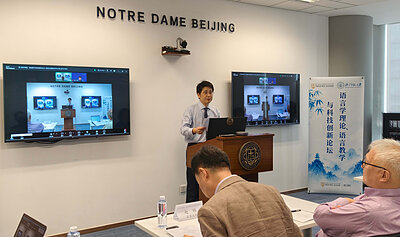
The two-day forum was chaired and moderated by Professor Jincheng Liu of the University of Notre Dame, who also served as the U.S. Vice Chair. Opening remarks were delivered by the U.S. Chair, Professor Yongping Zhu (University of Notre Dame); the Chinese Chair, Professor Liping Feng (dean of SICLE at BNU); and Ms. Jingyu Wang (executive director of Notre Dame Beijing). They extended a warm welcome to the attending experts and scholars, expressed sincere gratitude for the long-standing support from all sponsoring parties, and voiced their hopes that these in-depth exchanges would further advance academic cooperation and discipline development in the field of International Chinese Language Education.
The forum featured 16 exceptional academic presentations by renowned scholars from leading universities in China and the United States. Covering a wide range of cutting-edge domains in International Chinese Language Education—from fundamental linguistic research and cultural pedagogy to second language acquisition and AI applications—the presentations both reaffirmed the essential theoretical foundations of language teaching and actively addressed new challenges facing the field in the AI era. Attendees engaged in lively, meaningful discussions following each presentation, deepening the core themes and broadening the scope of research.
Closing remarks were delivered by Professor Chih-p’ing Chou of Princeton University and Professor Yang Zhao of Peking University, who congratulated the organizers on the forum's resounding success. They also expressed high hopes for further strengthening academic exchanges between linguists in China and the U.S., while continuously driving innovation and development in linguistic research and International Chinese Language Education.
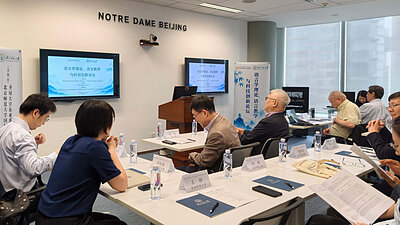
Professor Yongping Zhu attributed the success of the forum to the high-quality academic presentations by distinguished scholars, as well as the strong support of the collaborating institutions and Notre Dame Beijing. He expressed his confidence that the forum’s distinctive approach—bringing together cutting-edge theories, pedagogical practices, and technological developments to explore issues in language research and teaching—would have a positive impact on both the linguistic and language-teaching communities.
Conducted in a hybrid format, the forum attracted over 463 registrants from 278 institutions and organizations across 28 countries and regions—spanning North America, Asia, Europe, and Oceania. Attendees represented premier global institutions, including Princeton University, Stanford University, Yale University, Peking University, the University of Hong Kong, and the University of Macau, fully demonstrating the forum's international reach and significant global interest.
Originally published by at beijing.nd.edu on September 11, 2026.